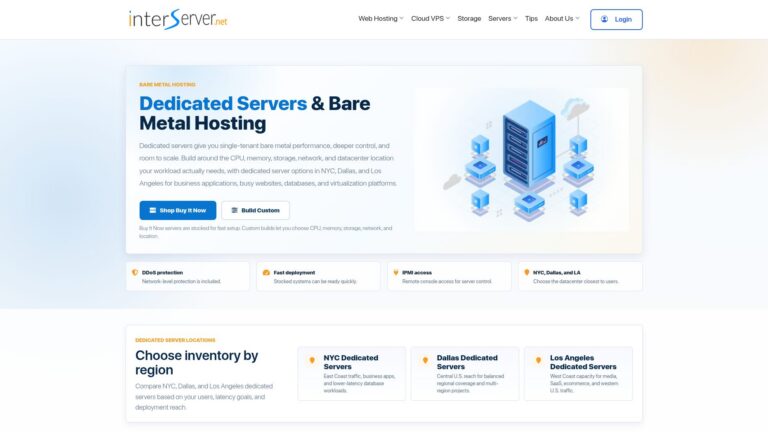

A dedicated server assigns one physical machine to one customer, removing unrelated provider tenants from the local host. The customer may run an operating system directly or install a hypervisor for internally managed virtual machines. Any performance advantage must be confirmed through equivalent workload testing.
The question is not whether dedicated servers deliver on that promise — they do — but whether a specific provider’s model fits your team’s operational reality. InterServer has operated since 1999 as an independently owned hosting company, building a reputation around advertised price-lock policies for eligible services and broad configuration flexibility rather than aggressive promotional cycles.
For buyers who have watched renewal rates climb sharply after an introductory period elsewhere, that positioning is immediately relevant. InterServer operates infrastructure in the United States, but buyers should verify the operator, ownership arrangement, facility address, network design, and service scope for the specific location in which their server will be provisioned.
This portrait examines who gains the most from InterServer’s dedicated server model, where the trade-offs are real, and what to verify before committing.
InterServer as a brand: who is behind the offering
InterServer is an independently owned hosting company founded in 1999, and that ownership structure has a direct consequence for buyers: pricing, hardware, and support decisions are made internally rather than through a conglomerate’s margin requirements.
InterServer operates infrastructure in the United States, but buyers should verify the operator, ownership arrangement, facility address, network design, and service scope for the specific location in which their server will be provisioned.
The brand’s dedicated server positioning rests on serving technically proficient buyers: developers, small-to-medium business operators, and DevOps teams who are equipped to manage their own environments. That audience fit is consistent and honest across the product line. The unmanaged model hands full administrative responsibility to you, which suits buyers with sysadmin capacity but creates a genuine gap for teams that lack it.
InterServer advertises a price-lock policy for eligible services. Before purchase, confirm in writing which recurring charges are locked and whether taxes, licences, control panels, managed support, bandwidth upgrades, hardware changes, or optional services can change. For buyers calculating total cost of ownership across a 12- or 24-month horizon, a confirmed lock scope can simplify budgeting relative to promotional pricing structures.
Buyers who need deep managed support or infrastructure distributed across multiple global regions will encounter the model’s limits before they reach its strengths.

InterServer sits between budget resellers and enterprise specialists — a deliberate middle ground worth understanding.
Market position of InterServer among known providers
InterServer occupies a distinct mid-market position in the dedicated server landscape: it is neither a budget reseller competing purely on entry-level price nor a premium managed specialist targeting enterprise compliance buyers. Its competitive identity rests on infrastructure ownership, billing transparency, and hardware flexibility — qualities that appeal to a specific buyer profile rather than the broadest possible market.
Within the dedicated server category, the provider sits alongside names such as Hostwinds and Hivelocity — both of which compete on hardware customization and straightforward pricing rather than deep managed services. For buyers evaluating bandwidth policy, it is worth noting that several providers apply monthly transfer caps with overage charges that can meaningfully inflate real costs for high-traffic workloads.
For a media streaming operation or a SaaS platform with variable traffic spikes, that distinction is worth pricing carefully.
Brand awareness is a genuine limitation. InterServer’s marketing presence is smaller than that of major competitors, and its client interface is considered dated by some users compared with providers that have modernized their control panels in recent years. For a technically proficient buyer who evaluates a provider on infrastructure substance rather than dashboard aesthetics, this is a minor friction point.
For a non-technical team expecting a polished self-service experience, it is a more meaningful gap.
The provider’s US-centric data center footprint also defines its geographic scope honestly. Teams whose user base is concentrated in the United States will find the latency profile acceptable. Organizations serving audiences across Europe or Asia-Pacific should treat that limited geographic reach as a concrete constraint, not a minor footnote, when comparing options.
Who InterServer is for — and who should look elsewhere
InterServer is the strongest fit for technically self-sufficient buyers who want dedicated hardware without paying a management premium. Developers running custom application stacks, DevOps teams maintaining their own deployment pipelines, and small-to-medium business operators who already have sysadmin capacity in-house gain the most from the model: broad OS choice and an advertised price-lock policy for eligible services – confirm in writing which recurring charges remain fixed.
Teams without in-house sysadmin capacity will find an unmanaged server a liability, not a bargain.
The profile extends naturally to workloads where traffic volume is high and unpredictable. A SaaS platform scaling through a growth phase, a gaming community running persistent game servers, or a media site with irregular traffic spikes should verify whether the selected InterServer configuration includes unmetered or flat-rate bandwidth and under which acceptable-use, throttling, and overage conditions that policy applies.
The picture shifts for teams that need managed support as part of the contract. Organizations without dedicated infrastructure staff — a marketing agency running high-traffic client campaigns, for example, or a startup that needs a provider to share operational responsibility — will find an unmanaged orientation a genuine gap rather than a minor inconvenience.
Geography is a further filter. InterServer’s primarily US-centric data center footprint serves US-based audiences well. Any organization with a significant user base in Europe or Asia-Pacific should compare providers with multi-region coverage before committing.

Flat-rate pricing, generous bandwidth, and years of operational history give InterServer a measurable edge.
Strengths that make InterServer stand out
Three practical strengths define InterServer’s position in the dedicated server market: a transparent pricing model, a bandwidth policy that may avoid overage charges on eligible configurations (verify per plan), and an operating history that gives buyers a longer record to evaluate – without proving current reliability by age alone.
InterServer advertises a price-lock policy for eligible services. Before purchase, confirm in writing which recurring charges are locked and whether taxes, licences, control panels, managed support, bandwidth upgrades, hardware changes, or optional services can change. Many providers advertise an attractive entry rate and then increase it at renewal — sometimes sharply — so a written lock scope matters more than the marketing label.
That predictability has real operational value, particularly for small businesses and bootstrapped SaaS teams where unplanned cost increases create cash flow friction.
Some InterServer configurations may include unmetered or flat-rate bandwidth. Verify the selected server’s port speed, transfer policy, acceptable-use restrictions, throttling conditions, overage treatment, and DDoS-related traffic handling before calculating total cost. Providers that apply monthly transfer caps can still inflate real costs during traffic spikes, so confirm the exact terms for the chosen plan.
The third strength is longevity. InterServer’s operating history provides a longer record for buyers to evaluate. Longevity alone does not establish current reliability, so review recent SLA terms, incident handling, infrastructure documentation, and customer-support performance. Also verify operator, ownership arrangement, facility address, network design, and service scope for the specific location where the server will be provisioned.
InterServer also offers both unmanaged and managed dedicated server options, along with wide OS and control panel flexibility, giving buyers a choice of operational model and stack configuration at the point of purchase.

Limited data center locations, a no-frills interface, and assumed technical skill are real constraints to weigh.
Trade-offs and weak spots of InterServer
InterServer’s core trade-offs are straightforward: a limited global footprint, an interface that prioritizes function over polish, and a support model that assumes a degree of technical self-sufficiency that not every buyer possesses. Understanding these constraints before signing up prevents a costly mismatch.
The most concrete structural limitation is geographic coverage. A primarily US-centric data center footprint means that latency for users in Europe or Asia-Pacific is a fixed cost of the architecture — no configuration choice eliminates it. For any organization whose audience is geographically distributed, that limited geographic reach is a hard constraint, not a preference.
The second trade-off is the management model. InterServer offers both unmanaged and managed dedicated server options, but its positioning and reputation are built around unmanaged infrastructure. Teams without in-house sysadmin capacity who select an unmanaged plan take on full operational responsibility for the server environment.
That is a reasonable arrangement for experienced DevOps teams, but it is a genuine operational risk for smaller organizations that underestimate what self-management requires day to day. Buyers considering a managed plan should confirm the specific scope of what is covered before purchasing.
The interface and control panel experience is a third area where InterServer lags behind more recently built competitors. The tooling works, but the user experience reflects a provider that has prioritized infrastructure ownership over front-end investment. For technically fluent teams, this is a minor friction point. For non-technical buyers evaluating ease of administration, it is worth factoring into the decision alongside raw hardware value.
Lineup and offer of InterServer at a glance
| Buyer | What they sell you | A fit if | Not a fit if |
|---|---|---|---|
| Inventory SKU shoppers | Ready-to-order boxes with named CPUs: e.g. Xeon E3-1270v2 at $45/mo (32 GB, 2×2 TB SSD, NYC), Ryzen 5900X at $116/mo (64 GB, 4 TB NVMe), dual Xeon E5-2680v3 24-core lines. Filters by core count, Ryzen, and under $99. Some SKUs show sold out. | You pick a live inventory row (or a Ryzen build) instead of a generic unmanaged tier name. | You need a three-plan Value/Power/Enterprise grid with intro/renewal pricing as the product. |
| NYC / Dallas / LA only | The dedicated catalog is three US metros. Hardware varies by location and current inventory. 1 Gbps unmetered is a headline; some SKUs list a 10 Gbps port. | US East/Central/West is enough and you will check which SKUs are actually in that city. | You must order Frankfurt, Amsterdam, or Singapore as a SKU filter. |
| Self-serve metal + optional support | IPMI/iLO, remote KVM, remote reboot, remote OS reinstall, zero setup fees. Managed support is a separate options page, not a second dedicated SKU family on the catalog. | You will run the OS and may buy support as an add-on. | You need a fully managed WordPress/cPanel SKU as the default product. |
| GPU / colo as sibling catalogs | GPU/AI compute and colocation are separate InterServer paths, not extra rows on every dedicated SKU. | You will open the GPU or colo catalog if that is the job. | You expect an H100 filter on the cheap Xeon E3 row. |
InterServer structures its dedicated server offering around a single core principle: configurable bare-metal hardware at a stable, predictable price. Rather than presenting a rigid ladder of fixed tiers, the provider allows buyers to assemble a configuration that matches their specific workload. That build-your-own approach means the entry point and the ceiling are both defined by what you actually need, not by a preset bundle designed for the median customer.
A documented price lock on eligible recurring charges can reduce renewal uncertainty, provided the exclusions are understood before purchase.
Some InterServer configurations may include unmetered or flat-rate bandwidth. Verify the selected server’s port speed, transfer policy, acceptable-use restrictions, throttling conditions, overage treatment, and DDoS-related traffic handling before calculating total cost. For workloads with variable or high-volume traffic, confirmed terms matter more than a generic unmetered claim.
InterServer advertises a price-lock policy for eligible services. Before purchase, confirm in writing which recurring charges are locked and whether taxes, licences, control panels, managed support, bandwidth upgrades, hardware changes, or optional services can change. That stands in contrast to providers whose promotional pricing diverges sharply from renewal rates — a pattern that can create hidden cost exposure over a 12- or 24-month horizon when lock scope is unclear.
Management options span unmanaged and managed arrangements, giving buyers a choice of operational model at the point of purchase. The unmanaged path suits teams with established DevOps capacity; the managed path reduces day-to-day operational overhead for those who prefer to focus on application-layer concerns. Both paths sit within the same hardware ecosystem, so a team’s management preference does not constrain its hardware choices.
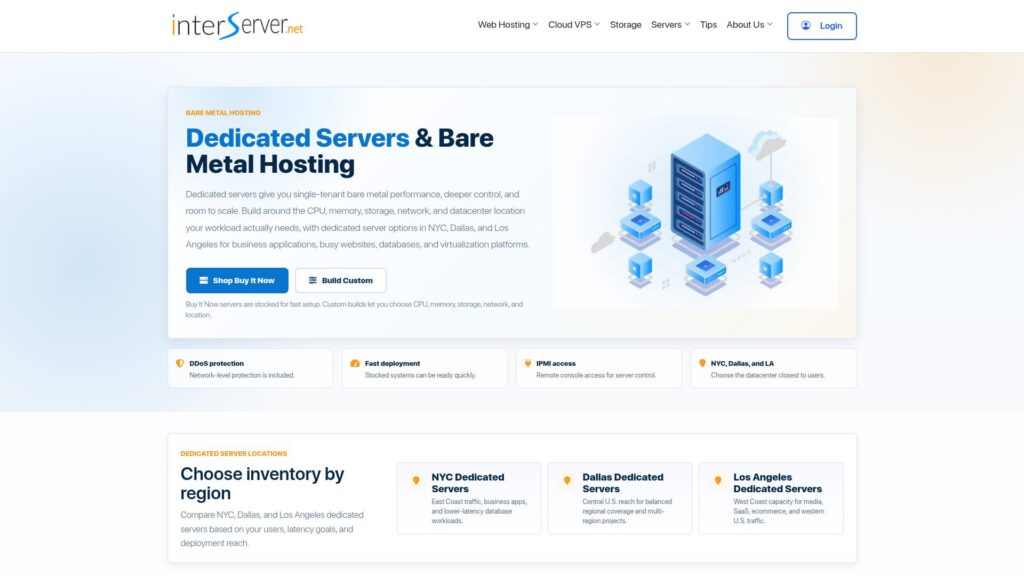

Published operations emphasize in-house support and owned data-center proximity; treat uptime as a contract question, not a reputation score.
InterServer in daily use: operational implications
InterServer’s day-to-day reputation centers on two consistent themes: reliable uptime and a support team that operates in-house rather than through outsourced contractors. For technically proficient buyers, that combination tends to translate into a stable hosting environment where escalations reach engineers who understand the underlying infrastructure rather than front-line agents reading from scripts.
The in-house support model carries practical weight for dedicated server customers. When a hardware issue arises at an inconvenient hour, the difference between a knowledgeable internal team and a tiered outsourced queue is measurable in recovery time.
InterServer’s owned data center infrastructure means the engineers handling support work in proximity to the physical hardware they are troubleshooting, which tends to reduce the handoff friction that slows resolution at providers who lease colocation space and rely on third-party data center staff.
On the self-management side, the experience diverges by team profile. Buyers with established sysadmin capacity find that the unmanaged environment delivers exactly what they expect: root access, hardware exclusivity, and no platform-level interference with their stack. The absence of a polished control panel is a non-issue for teams managing servers through SSH and configuration management tools.
For buyers expecting a guided administration experience, the interface gap becomes more noticeable over time — particularly when comparing InterServer’s tooling against providers who have invested more heavily in front-end development in recent years.
Bandwidth cost predictability depends on the selected configuration. Confirm port speed, transfer policy, acceptable-use restrictions, throttling, overage treatment, and DDoS-related traffic handling before treating bandwidth as a fixed line item.
Conclusion – Is InterServer the right choice for you?
InterServer’s dedicated server offer is built around three structural commitments: hardware exclusivity through single-tenant bare metal, an advertised price-lock policy for eligible services (confirm locked charges in writing), and a bandwidth policy that keeps monthly costs predictable regardless of traffic volume.
Those three elements, taken together, address the most common financial frustrations in the dedicated hosting market — not through promotional positioning, but through the mechanics of how the plans are actually structured. For teams that have outgrown shared or VPS environments and need a stable, controllable infrastructure foundation, that combination carries genuine long-term value.
The fit is clearest for technically capable teams — developers, DevOps engineers, and technically inclined founders — who want full hardware control without being locked into escalating renewal costs. Organizations that require managed hand-holding or a globally distributed data center footprint will need to weigh those gaps honestly before committing.
If the profile matches your workload and your team’s operational capacity, exploring the Dedicated Server offer directly is the most efficient next step — the configuration options and pricing structure are best evaluated against your specific requirements rather than in the abstract.