
Hostwinds* sells US dedicated servers from facilities it operates. The useful question is not the SKU list — it is which constraints stay off the order form: renewal rates, managed-tier scope, and who should not buy.
Hostwinds as a brand: who is behind the offer
Hostwinds is a US-based hosting provider founded in 2010. Verify the current dedicated-server locations, facility operators, and ownership arrangements from official documentation before relying on them for procurement or compliance. It is privately held and has grown without the acquisition-driven rebranding cycles that have diluted accountability at several larger hosting groups — a structural detail that matters when you are evaluating long-term vendor reliability for dedicated infrastructure.
The brand’s dedicated server division is built for a specific buyer profile: technically capable teams that want physical, isolated hardware and the freedom to configure it precisely, without paying for managed overhead they do not need. That positioning shapes everything downstream — the configurator, the support model, and the pricing structure. If you match that profile, Hostwinds delivers genuine control. If you do not, the same characteristics become friction points rather than advantages.
Where Hostwinds sits in the market is less about scale and more about fit. It does not compete with hyperscale cloud on elasticity, and it does not compete with enterprise-tier managed providers on hand-holding. Its recognizable position in the dedicated segment is as a mid-market option for DevOps teams, growing SaaS operations, and e-commerce businesses that have outgrown shared environments and have at least one person capable of owning server administration internally.
Understanding that positioning before you evaluate pricing, management tiers, or support posture will save you from benchmarking Hostwinds against providers built for an entirely different buyer.

Hostwinds occupies a configurable segment of the dedicated-server market. Compare its hardware, support, pricing, and SLA terms with equivalent current offers rather than assuming superior build quality or support.
Hostwinds in peer context — without a competitor showdown
That positioning has a practical consequence for you: the value proposition holds only if your team profile matches the product’s actual operating model.
Where that fit breaks down most predictably is at the edges of the managed tier. Smaller e-commerce or gaming operations often enter expecting managed scope comparable to enterprise alternatives, then encounter a narrower service boundary — one that covers infrastructure availability but stops short of architecture guidance or proactive performance tuning.
Unmanaged dedicated pricing at the performance tier also runs higher than equivalent VPS or cloud instances, which is only justifiable if your workload genuinely requires isolated hardware.
The cost delta between unmanaged and managed plans compounds this: teams that budget for managed pricing but still carry internal sysadmin overhead to compensate for scope gaps end up paying for redundancy rather than relief. If your team is still scoping requirements or expects the support channel to cover configuration decisions, these misalignments will create friction rather than resolve it.
The sections below map each of these dimensions — management tier, price structure, and support model — to specific team profiles.
Who Hostwinds is for — and who should look elsewhere
Hostwinds dedicated servers are a strong fit for technically self-sufficient buyers: DevOps engineers, infrastructure architects, and technical founders who arrive with a precise hardware specification in mind and want to configure storage, RAM, and CPU independently rather than accept a pre-packaged bundle that either over-provisions or under-delivers. The granular build process rewards that kind of deliberate purchasing and avoids forcing you to pay for capacity you will never use.
If you do not have an in-house sysadmin, unmanaged hosting represents a recurring operational cost that does not appear on the pricing page. Every OS update, security patch, service failure, and configuration change falls to you. Treating the lower price as a straightforward saving, rather than a transfer of labour, is the most common miscalculation buyers make with this tier of hosting.
E-commerce operators, SaaS teams, and gaming platform owners have a genuine use case here. Dedicated physical hardware eliminates the resource contention that comes with shared or virtualized environments, which matters when traffic spikes are unpredictable or when compute-intensive workloads need consistent throughput. The absence of noisy neighbours is a practical advantage, not a marketing point.
Where Hostwinds is a weaker match: if your organization operates under regulatory frameworks that require documented compliance certifications — specific audit trails, formal attestations, or jurisdiction-specific data handling guarantees — you should independently verify whether Hostwinds meets those requirements before committing.
The billing structure is also worth examining early; Hostwinds uses hourly billing on some configurations, which suits short-term or variable workloads but can complicate budget forecasting for teams accustomed to fixed monthly infrastructure costs.

The ability to define CPU tier, RAM allocation, and storage layout before provisioning begins gives buyers meaningful control over their environment and reduces the likelihood of costly reconfigurations after deployment.
What Hostwinds does especially well
Hostwinds’ clearest practical strength is the depth of its configuration process at the point of order. Where many providers lock buyers into fixed hardware tiers, Hostwinds allows customers to define their server environment before provisioning begins. That level of specificity matters for teams that have already modeled their resource requirements and do not want to overpay for headroom they will never use — or discover mid-contract that a fixed SKU undershoots their actual workload.
That single design choice positions Hostwinds* as a provider built around buyer-defined precision rather than catalog convenience.

Three structural limitations — support depth tied to managed tiers, limited transparency around hardware refresh cycles, and constrained network customization — will matter more to your decision than any advertised specification.
Honest limits before you commit to Hostwinds
Three constraints at Hostwinds will determine whether the platform fits your situation before pricing or specs become relevant.
First, the support posture is structured, not reactive. Hostwinds offers 24/7 live chat and ticketing, but the depth of assistance scales directly with your management tier. On an unmanaged plan, support covers infrastructure and network — not your application layer, your configuration choices, or your recovery path after a misconfiguration. If your team cannot own those responsibilities internally, a managed plan is not an optional upgrade; it is the baseline you should price from the start.
Second, provisioning timelines are not instant. Dedicated hardware requires physical allocation, which introduces lead times that cloud infrastructure does not. If your workload involves sudden capacity demands or a time-sensitive migration window, confirm current provisioning estimates with Hostwinds directly before committing — this is not a detail to resolve after signing.
Third, the pricing model rewards buyers who arrive with defined requirements. Hostwinds uses a configurable build structure where RAM, storage, and bandwidth are selected individually. That approach suits a DevOps team with precise spec requirements. It creates friction for anyone still scoping their infrastructure needs, because there is no guided tier to anchor expectations against.
How Hostwinds structures its product lines
| Buyer | What they sell you | A fit if | Not a fit if |
|---|---|---|---|
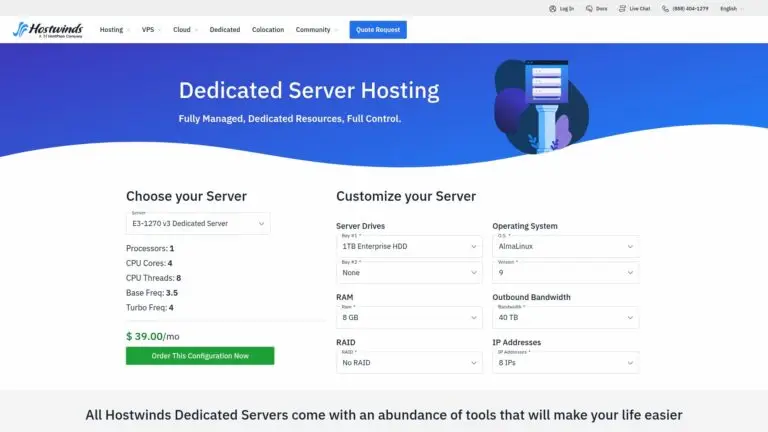
| E3-1270 v3 and sibling E3 codes | Default SKU: E3-1270 v3, 4 cores / 8 threads, 3.5/4.0 GHz, $98/mo. Also listed: E3-1270 v2, E3-1240 v2, E3-1271 v3, E3-1270 v5, E3-1270 v6. Disks, RAM, RAID, and OS are configurator fields (example: 1 TB HDD bay, +$8 for 8 GB RAM, AlmaLinux 9, 40 TB bandwidth, 8 IPs). | You will pick an E3 code and size disks and RAM on that SKU. | You need a dual-EPYC 64-core row as the published default. This grid is E3-12xx. |
| 1 Gbps link and 40 TB pool | The dedicated page gives a 1 Gbps network link. Outbound bandwidth in the configurator starts at 40 TB. | 1G plus a 40 TB pool is enough, and you will check the dropdown if you need more. | You shop first by 10G or 100G as a catalog filter. |
| RAID 0–60 and IPMI | RAID 0 through 60, depending on disk count. Nearly all dedicated servers include IPMI (KVM, power, ISO mount); a few SKUs do not. | You will set RAID and use IPMI, and you will confirm your SKU is not one of the exceptions. | You need IPMI guaranteed on every SKU with no exception. |
| Management included | Each dedicated server includes full management, monitoring, and nightly backups. The dedicated page says they have facilities in various locations worldwide; it does not name cities. | You want ops included on the box you configure. | You need a city list on the dedicated page before you buy. |
Hostwinds exposes individual hardware variables as selections during the buying process, producing a build-your-own model that suits buyers who arrive with a precise specification in mind rather than those who prefer a curated shortlist.
The structural consequence of that approach is a meaningful divergence in procurement experience depending on buyer type: teams with a confirmed bill of materials move through the process efficiently, while teams still evaluating their requirements encounter an open-ended interface with no preset bundles to anchor against.
This structure has a practical consequence for procurement. A team provisioning a server for AI inference workloads may prioritize certain hardware characteristics above all else, while a gaming platform operator may weight other variables more heavily. Because selections are made independently, both buyers can configure from the same underlying product line without being forced into a tier that bundles unwanted resources.
The trade-off is that the process demands more upfront clarity about requirements. Buyers who are uncertain about their needs may find an open-ended configurator less intuitive than a provider that pre-selects sensible defaults within a named plan.

Hostwinds dedicated is least painful when you already know the CPU, RAM, and storage you need; it is a poor fit if you expect the order flow to design the machine for you.
Hostwinds in daily use: operational implications
Buyer satisfaction with Hostwinds dedicated servers correlates strongly with how clearly you have defined your requirements before provisioning — not after. Teams who arrive with a confirmed CPU tier, RAM allocation, and storage layout report that the configurator delivers exactly what they selected, with billing that remains predictable across renewal cycles.
The friction emerges when those decisions are deferred: hardware change requests after provisioning introduce lead times that buyers describe as inconsistent, and that inconsistency is the most common source of negative feedback rather than outright service failure.
Test the pre-sales and support process with a workload-specific question. Obtain written response targets, escalation paths, management boundaries, renewal pricing, bandwidth charges, and add-on costs before committing.
Hostwinds support is staffed to resolve, not to consult, and buyer reports make that distinction clearly.
Test the pre-sales and support process with a workload-specific question. Obtain written response targets, escalation paths, management boundaries, renewal pricing, bandwidth charges, and add-on costs before committing.
The configurator exposes all of this information, but it requires active engagement rather than passive reading.
Taken together, the buyer record positions Hostwinds as a reliable operational environment for teams that bring defined requirements to the table, and a less predictable one for teams that expect the vendor to help shape those requirements.
Next step
Open Hostwinds’s live configuration and support scope on the provider side, then decide with clear criteria.
*
Advertisement
Conclusion – Is Hostwinds the right choice for you?
The fit here is real, but it is narrow — and it maps most cleanly onto two buyer types: a DevOps team running containerized workloads that needs custom RAM, storage, and OS combinations without paying for bundled overhead, and a SaaS operator scaling a transactional application where resource contention on shared infrastructure has already become a measurable problem. Both profiles extract clear value from the build-your-own model. Most others will encounter friction before they encounter value.
Hostwinds suits you best if you arrive with a defined infrastructure requirement, an in-house team capable of managing unmanaged Linux or Windows environments, and a budget that absorbs premium hardware pricing in exchange for granular configurability. Support is available around the clock across live chat, ticket, and phone channels — a posture that complements technical teams who need rapid escalation paths rather than guided hand-holding.
If your team lacks dedicated sysadmin capacity, or if your budget ceiling aligns more naturally with managed cloud tiers, Hostwinds* dedicated servers introduce operational overhead that outweighs the hardware advantages. Knowing which side of that line you stand on is the decision this overview is designed to inform.