
A dedicated server gives you exclusive use of a physical machine — no shared CPU, no shared RAM, and no hypervisor layer dividing the hardware among strangers. That single-tenant foundation is precisely why regulated industries and high-stakes workloads gravitate toward bare metal. The absence of a hypervisor removes one class of risk entirely. It also removes one layer of automatic isolation.
When you run containers or workloads of differing sensitivity on the same physical host, the kernel itself becomes the last meaningful boundary between them. This is the challenge that container isolation on bare metal surfaces. In a virtualized environment, a hypervisor enforces hard separation between tenants at the hardware level. On a dedicated server, that separation does not exist by default.
A containerized payment-processing service and a development environment sharing the same kernel are closer to each other than most teams realize. Without deliberate configuration, a misconfigured namespace, an overly permissive capability set, or a kernel exploit can collapse the boundary between workloads that were never meant to touch.
For organizations running mixed-sensitivity workloads — production alongside staging, cardholder data alongside analytics pipelines — this is not a theoretical concern.
What Is Dedicated Server Container Isolation?
Container isolation on a dedicated server is the practice of enforcing security boundaries between containerized workloads at the operating system kernel level, because no hypervisor exists to enforce those boundaries at the hardware level. Every container running on bare metal shares the host kernel. That shared kernel is both the efficiency advantage of containers and their fundamental security constraint.
Three kernel mechanisms form the primary enforcement layer. Namespaces restrict what a process can see — network interfaces, process trees, mount points, and user IDs can each be scoped to a specific container. Control groups, commonly called cgroups, limit what a process can consume in terms of CPU, memory, and I/O, preventing one workload from starving another.
Seccomp profiles filter the system calls a container is permitted to make, reducing the attack surface available if a workload is compromised. On a virtual machine, these mechanisms are supplementary hardening. On bare metal, they are the primary line of defense.
Workload sensitivity classification is the prerequisite step that makes isolation meaningful. Before any technical control is applied, each workload must be assigned a sensitivity tier: for example, production services handling regulated data sit at a higher tier than internal development environments or analytics pipelines. That classification determines which namespaces are enforced, which seccomp profiles are applied, and whether workloads may share a network bridge at all.
Without that classification, isolation decisions become arbitrary.
The implementation details behind each layer are covered in the sections that follow.
Without a hypervisor enforcing separation, a single container breakout on bare metal can expose every co-located workload to lateral movement across the entire host.
Why Mixed-Sensitivity Workloads Demand Explicit Boundary Design
Co-locating workloads of different sensitivity levels on a single bare-metal host is fundamentally riskier than doing so on virtualized infrastructure, because no hypervisor enforces a hard separation layer between them. On bare metal, a container that escapes its namespace restrictions reaches the host kernel directly and can interact with every other workload on the same machine — a blast radius that virtualized guests naturally constrain by their guest OS boundary.
The harder operational question is where to draw those boundaries when workload sensitivity is uneven or changes over time. Static classification schemes fail most visibly during transitional states: a development pipeline promoted mid-cycle to handle regulated data, or a batch job that temporarily requires elevated Linux capabilities unacceptable to a neighboring production context.
Those transitional windows are precisely when boundary design must be explicit rather than assumed — because an undocumented exception made under time pressure is indistinguishable, to an auditor, from a control that was never in place.
The harder operational question is where to draw those boundaries when workload sensitivity is uneven or changes over time — for example, when a development pipeline is promoted to handle regulated data mid-cycle, or when a batch job temporarily requires elevated Linux capabilities that would be unacceptable in a neighboring production context. Those transitional states are where boundary design fails most often, because static classification schemes do not account for runtime privilege changes.
The practical consequence is a wider blast radius per misconfiguration. Consider a development pipeline running alongside a production service that handles regulated data. On virtualized infrastructure, the two environments occupy separate guest kernels, and a privilege escalation in the development container does not automatically threaten the production workload. On bare metal, both environments share one kernel.
A container granted excessive Linux capabilities — for example, CAP_SYS_ADMIN, which permits a broad range of privileged kernel operations — can mount host filesystems, manipulate network namespaces belonging to other containers, or read memory regions outside its intended scope. The development container becomes a lateral movement path into the production environment.
This is not a hypothetical edge case. Container runtime vulnerabilities that exploit kernel interfaces have been publicly documented, and their exploitability scales directly with the privilege level the container was granted at startup. Capability minimization at configuration time is therefore not optional hardening; it is the primary control that limits how far a compromised container can reach across the host.
Those decisions must be documented and enforced consistently — not left to runtime defaults.
How Do Kernel Namespaces and Cgroups Enforce Workload Separation?
Container isolation may use PID, network, mount, UTS, IPC, user, cgroup, and time namespaces as supported and required. The necessary set depends on the runtime and threat model; four namespace types should not be presented as a universally complete isolation boundary.
A missing cgroup limit lets one container starve every other workload on the same physical host.
Linux namespaces partition global kernel resources into isolated views. The PID namespace gives each container its own process tree, so a container cannot enumerate or signal processes belonging to a neighboring workload. The net namespace provides a separate network stack — including interfaces, routing tables, and firewall rules — meaning one container cannot sniff or inject traffic into another container's network path by default.
The mnt namespace isolates the filesystem view, preventing a container from traversing mount points that belong to the host or to a different workload. The UTS namespace isolates hostname and domain name, which matters when workloads rely on hostname-based identity or logging correlation. Each namespace type addresses a different kernel resource. The required namespace set depends on the runtime, workload, and threat model; namespaces must also be combined with capability restrictions, seccomp, mandatory access controls, and appropriate network and resource boundaries.
Cgroups complement namespaces by enforcing resource ceilings. A container without cgroup limits can exhaust host CPU, memory, or I/O bandwidth, degrading or crashing adjacent workloads. For mixed-sensitivity environments, cgroup limits serve a dual purpose: they prevent accidental resource starvation and they constrain the speed at which a compromised container can execute resource-intensive operations such as cryptographic brute-force or large-scale memory scanning.
The critical nuance is that namespaces restrict visibility, not capability. A process inside a net namespace still retains any Linux capabilities granted at startup, including those that allow raw socket creation or network namespace manipulation.
Namespace scope and capability scope are orthogonal controls, and treating namespaces as a complete isolation boundary without pairing them with explicit capability restrictions leaves a gap that container runtime vulnerabilities — including those documented under CVE-2019-5736 and CVE-2022-0185 — have demonstrated is exploitable.

Documenting workload sensitivity tiers before applying any technical controls is what transforms ad hoc container hardening into an auditable, defensible compliance posture.
Scoping Security Boundaries by Workload Sensitivity Classification
Classifying workloads by sensitivity before configuring any isolation is the step that transforms container hardening from a technical exercise into a defensible compliance posture. Without a documented classification, every workload on the host implicitly shares the same security tier — and auditors treat that as a scope expansion, not a simplification.
A practical classification framework groups workloads into at least three tiers. The first tier — regulated-data workloads such as payment processors, PHI handlers, and credential stores — requires the strictest isolation profile: dedicated network namespaces, no shared volumes with lower-tier containers, and cgroup limits that prevent resource-based side-channel attacks.
The second tier covers services adjacent to regulated data without touching it directly: authentication proxies, internal APIs, and logging forwarders that route data toward tier-one containers. These systems warrant strong isolation but can share certain host-level resources when access controls are explicitly documented.
The third tier covers public-facing application layers — web frontends, CDN origin servers, and marketing tooling — where the primary concern is containment rather than data-proximity risk. Systems that cannot reach the regulated-data environment through any documented network path can be formally excluded from the audit boundary, which shrinks the evidence package an assessor must examine and reduces preparation time before an assessment window opens.
Each tier boundary must be documented with network diagrams and access control matrices, not merely enforced at the kernel level. The boundary-documentation workflow — including which artifacts assessors typically request to validate scope decisions — is covered in the companion article on dedicated server compliance scoping.
Mapping each tier to a named isolation profile and storing that mapping as a version-controlled configuration document gives you a single authoritative reference when kernel configurations change or new workloads are onboarded, and it gives an auditor the traceability chain needed to confirm that enforcement matches intent.
Which Runtime Security Controls Close the Gaps Namespaces Leave Open?
Do not assume that the runtime’s default seccomp profile matches the workload. Review the active profile, retain its baseline restrictions, and narrow or extend it only when the application’s documented system-call requirements justify the change.
The practical tuning question is how narrow that allowlist should be, and whether operational teams will maintain it as workloads evolve. A profile written for an initial deployment tends to drift toward permissiveness over time as developers add capabilities to silence errors rather than audit the underlying need — which gradually erodes the protection the profile was meant to provide.
Mandatory access control frameworks such as AppArmor or SELinux operate at a different enforcement point, governing which files, sockets, and capabilities a process may reach regardless of its Unix user identity, and are most effective when maintained alongside seccomp rather than treated as a substitute for it.
A profile tuned for a web application, for example, has no reason to permit raw socket creation or kernel module loading — and blocking those calls prevents an entire class of privilege escalation techniques.
Where seccomp restricts what a process can ask the kernel to do, mandatory access control restricts what the kernel will permit that process to reach. The two mechanisms operate at different enforcement points and are most effective when deployed together rather than treated as alternatives.
Rootless container runtimes close a third gap: privileged mode abuse. When a container runtime itself runs as root on the host, a successful container escape immediately yields root access to the bare-metal environment. Rootless configurations map the container’s apparent root user to an unprivileged host user identity, so an escape lands with constrained permissions rather than full host control.
Layering these three controls — syscall filtering, mandatory access control, and rootless execution — produces a defense-in-depth posture that treats each mechanism as a distinct enforcement boundary. No single layer is sufficient; each addresses failure modes the others do not cover.
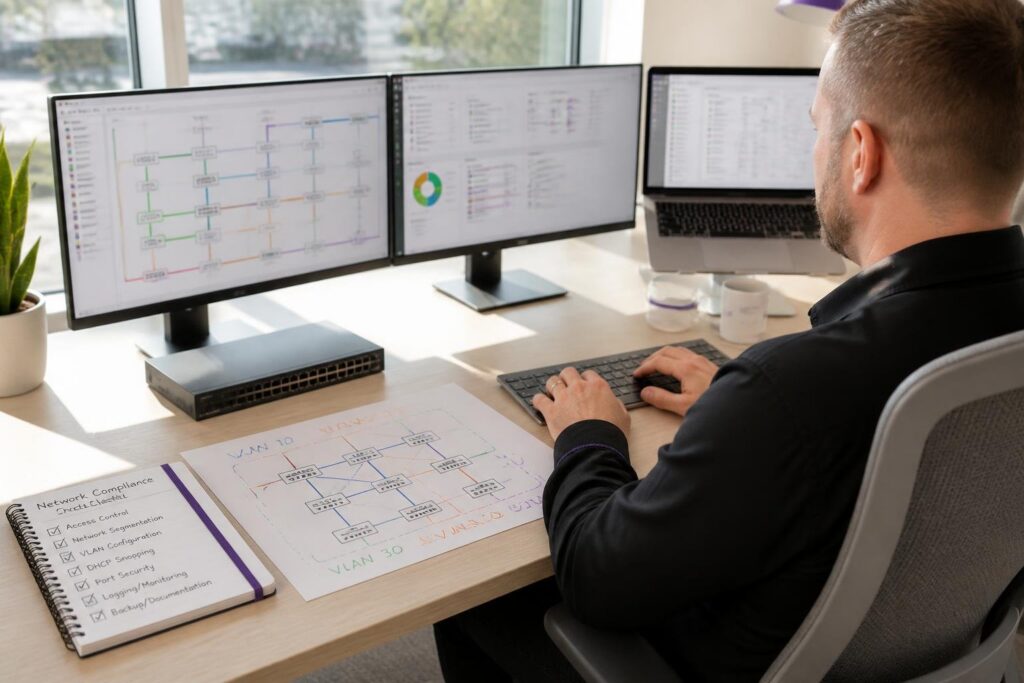
Enforcing traffic boundaries through separate bridge networks and VLAN tagging at the packet level ensures that a compromised container cannot reach higher-sensitivity workloads through application-layer bypasses.
Network Segmentation Patterns That Satisfy Compliance Auditors on Bare Metal
Separate bridges, VLANs, and host-level filtering can reduce unintended connectivity, but they do not remain trustworthy after a successful host-level compromise. Stronger isolation may require separate virtual machines or physical hosts for workloads with materially different trust levels.
A default-deny packet filter at the host level stops lateral movement before it reaches any application boundary.
Ingress and egress policy rules — applied at the host's packet filter rather than inside the container — define which source and destination pairs are permitted. Any traffic not matching an explicit allow rule is dropped. This default-deny posture is the pattern auditors look for when evaluating whether network controls are deliberate rather than incidental.
One detail teams frequently overlook is east-west traffic control: the implicit flows between containers on the same host. Lateral movement during an incident commonly follows internal paths that perimeter rules never addressed. Explicit inter-container policy — documented and version-controlled alongside the sensitivity classification map — closes this gap and gives auditors the boundary evidence they need.
Generating Audit-Ready Evidence from Your Container Isolation Configuration
Controls governing your container isolation configuration must exist as durable, versioned artifacts rather than runtime observations. An auditor cannot verify a configuration that exists only in memory at the moment of inspection, and a point-in-time screenshot provides no traceability — it cannot be diffed against a prior state, tied to a change record, or independently reproduced.
Each isolation layer produces a distinct evidence category, and each category belongs in version control: seccomp profiles defining which kernel calls a container process may invoke, mandatory access control policy modules governing file and capability access, rootless execution configurations, cgroup hierarchy definitions that bound CPU and memory allocation per workload class, and the bridge or VLAN definitions that enforce network boundaries between sensitivity tiers.
Every file should be tagged against the workload sensitivity classification established during scoping so that any control can be traced directly to the business justification that required it. That traceability is what transforms a collection of configuration files into a coherent compliance evidence package rather than a folder of disconnected artifacts.
Immutable evidence capture extends beyond static configuration files. Runtime enforcement decisions — seccomp policy denials logged by the kernel audit subsystem, mandatory access control violations recorded by auditd, and network policy drops captured at the bridge or VLAN boundary — generate events that must be collected and retained separately from the container they describe.
Storing these events in a location the container cannot write to is not optional: a process that can modify its own audit trail produces evidence an auditor cannot rely on. CVE-2019-5736, which allowed a container process to overwrite the host runc binary through a kernel interface, illustrates precisely why enforcement decisions must be logged at the host layer rather than within the container runtime itself.
The boundary between configuration evidence and log evidence is architecturally meaningful. Configuration files prove that a control was defined; log events prove that the control was enforced at runtime. Both are necessary, and neither substitutes for the other. The sibling article on building a compliant log stack covers the collection and retention architecture that complements the configuration layer described here.
What this article establishes is the upstream discipline: if your seccomp profiles, MAC policy modules, and network boundary definitions are not committed to a repository with associated change records before an audit window opens, the log evidence downstream has no policy baseline to reference — and the evidence package is incomplete regardless of how well the logging infrastructure performs.
Unchanged configuration defaults — such as the privileged flag or unrestricted kernel capabilities — represent the most common and consequential source of container isolation failures in production environments.
Common Isolation Failures and the Compliance Exposure They Create
The most damaging container isolation failures are not exotic zero-day exploits — they are configuration defaults left unchanged. Running a container with the privileged flag enabled grants that process nearly unrestricted access to the host kernel, effectively collapsing every namespace boundary that earlier sections described.
- Sharing the host PID namespace allows a container to observe and signal processes belonging to other workloads on the same machine
- Using an overly permissive seccomp profile—or disabling seccomp filtering—exposes unnecessary kernel system calls to container processes
- Mounting sensitive host filesystem paths into containers bypasses mnt namespace isolation entirely
- Failing to set cgroup resource limits enables resource-exhaustion attacks that can destabilize neighboring workloads
- Omitting network namespace separation gives compromised containers a routable path to higher-sensitivity workloads by default
- Storing no versioned configuration artifacts means auditors cannot verify that isolation controls existed or were enforced at any specific point in time
Shared host PID namespaces represent a subtler but equally consequential failure. When a container shares the host's process namespace, its processes can observe — and in some configurations signal — processes belonging to every other workload on the machine.
An auditor does not need to demonstrate active exploitation; the absence of the boundary is itself the finding. The same logic applies to overly permissive syscall profiles: shipping containers with a default-allow seccomp posture, or disabling syscall filtering entirely, removes the restriction layer that runtime security controls are designed to enforce. That omission appears in audit reports as an undocumented attack surface rather than a deliberate architectural decision.
Unrestricted inter-container networking — where every container on the host can reach every other container without an explicit policy — is the fourth failure pattern and the one most likely to expand unintentionally. When a low-sensitivity workload can initiate connections to a container processing regulated data, the boundary between those sensitivity tiers dissolves on paper as well as in practice.
Conclusion – Isolation Is a Design Decision, Not a Default
Container isolation on a dedicated server is not a feature you activate — it is a series of deliberate decisions made at provisioning time and enforced continuously thereafter. Every namespace boundary, seccomp profile, network policy, and cgroup limit either exists as a documented, auditor-traceable control or it does not exist at all.
Every isolation control must exist as a documented, auditor-traceable decision — or it effectively does not exist.
Treating isolation as a design discipline — scoped before deployment, encoded in version-controlled configuration, and validated against your sensitivity classification — is what separates a defensible compliance posture from a collection of settings that happen to be running.
Container isolation protects workload boundaries, but it does not secure administrative access to the host. Apply the identity, session, and privilege controls in Zero-Trust Access Controls for Your Dedicated Server to protect the management layer surrounding those containers.