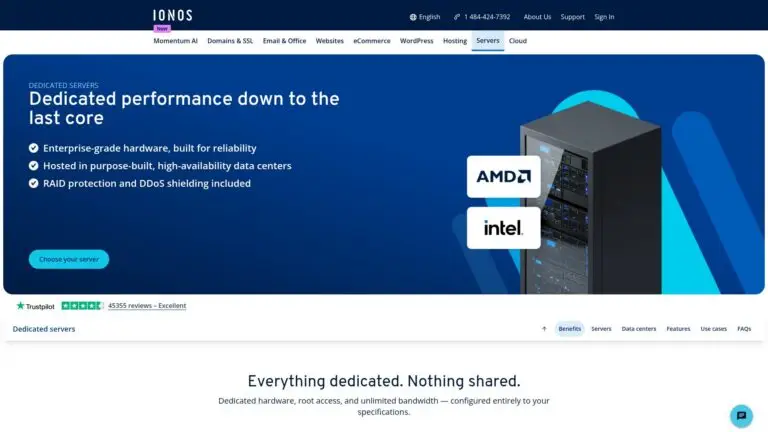

IONOS* occupies a distinctive position in the dedicated server market: it combines entry-level pricing with a support structure and bandwidth policy that are worth examining carefully — because the gap between what a provider advertises and what it actually delivers under sustained load is where decisions are won or lost.
This portrait focuses on what IONOS's dedicated server lineup concretely offers: how its hardware tiers, bandwidth and traffic policy, management approach, and data center footprint hold up against the demands of real workloads. You will find a clear account of where IONOS performs well, where its offering has limits, and which buyer profiles are genuinely served by its infrastructure — rather than a surface-level feature list that reads the same across every provider page.
The dedicated server category itself rewards careful evaluation. A bare metal server gives you exclusive use of a physical machine: no hypervisor layer, no shared CPU or RAM, no noisy neighbor consuming resources at peak moments. That architecture delivers consistent, predictable performance that shared hosting and most VPS tiers cannot replicate under load.
IONOS as a brand: who is behind the offer
IONOS is part of the publicly listed United Internet group. Buyers should verify the contracting entity, facility operator, network responsibilities, hardware-replacement obligations, and applicable compliance documentation for the selected product and location. Group ownership alone does not establish that every underlying asset or operational responsibility is handled by one entity.
This simplified structure is advantageous when preparing for internal procurement cases or third-party audit responses. IONOS operates data centers in Germany, Spain, and the United States, providing a robust jurisdictional base for teams with European operations and offering at least one non-European node for latency-sensitive or geographically distributed tasks.
While compliance certifications are publicly available, conducting a gap analysis against your specific audit framework remains essential, as IONOS documentation serves as a starting point rather than a complete solution.
The decision between managed and unmanaged service tiers significantly impacts your operational responsibilities. Unmanaged plans offer full root access and complete stack control. In contrast, managed plans have varying intervention boundaries, such as patching schedules and response guarantees, which are not uniformly detailed on public plan pages. It is crucial to obtain written confirmation of the exact scope before interpreting the managed label as a definitive service guarantee.
What the basic managed tier includes contractually — beyond OS-level support escalation — requires direct confirmation with IONOS before you size a workload across regions. Latency benchmarks and SLA specifics are not published in a form that allows independent regional evaluation without a sales conversation.

IONOS competes by delivering solid dedicated hardware at entry-level price points that undercut many mid-market rivals, making it a practical starting point for cost-conscious teams.
Market position of IONOS among known providers
IONOS positions itself at the accessible tier of the dedicated server market, competing on price-to-value rather than enterprise feature depth. Entry-level plans should be verified on the current IONOS product page (note your access date) rather than assumed to sit below €50 per month. Mid-range configurations with higher core counts and larger memory pools may remain competitive versus comparable raw compute from other European providers — compare equivalent plans and tooling depth directly.
For a growing technical team that needs predictable costs and self-managed bare metal without enterprise procurement overhead, IONOS is a credible fit. For teams operating under mandatory compliance frameworks or requiring hardware customization, the positioning has a defined ceiling that the current lineup does not clear.
Who IONOS is for — and who should look elsewhere
IONOS dedicated servers are a strong fit for technically self-sufficient teams operating on a defined infrastructure budget — SaaS operators, mid-sized e-commerce businesses, and digital agencies managing multiple client environments who handle their own provisioning, patching, and day-to-day administration.
Teams without a dedicated admin role will spend more recovering from incidents than they ever save on hardware costs.
If your team owns those responsibilities internally, IONOS delivers guaranteed compute, flat-rate bandwidth, and self-service provisioning without charging for managed-tier overhead you would not use.
The fit breaks down in two specific situations. First, if no one on your team owns server administration as a defined role, a managed-first provider will reduce operational risk faster than any hardware price advantage compensates for. Second, if your compliance requirements extend beyond what the published service catalog documents — relying instead on what a pre-sales conversation implies — the gap between expectation and contractual reality becomes a liability.

Flat-rate bandwidth bundled with affordable base configurations gives budget-focused teams a predictable monthly bill even when traffic patterns fluctuate unexpectedly.
Strengths that make IONOS stand out
Entry-level configurations should be verified on the current IONOS* product page (note your access date); flat-rate bandwidth is often marketed as included rather than metered — a combination that can reduce infrastructure cost when your team is managing variable traffic without a dedicated CDN budget. Verify current pricing against the IONOS configurator before treating any figure as contractual, as rates adjust with promotional cycles.
The cost advantage is most defensible at the entry and mid-range tiers, where raw compute relative to price holds up against the broader dedicated server market; at higher configurations, the gap narrows and the comparison becomes more hardware-specific. Flat-rate bandwidth and support availability may matter for teams operating without a fully managed provider — verify current bandwidth policy and support scope on official pages rather than relying on unattributed buyer-feedback summaries.
The value of 24/7 support depends on the contractual response and intervention scope. Confirm the available channels, first-response target, escalation process, hardware-replacement target, and whether engineers provide hands-on OS or application assistance. Do not treat general support availability as equivalent to a managed-service commitment.
Treat support as a dependable first line of contact, not a substitute for internal engineering competence. A growing technical team that has already mapped its incident response responsibilities will extract more from this support model than one that has not.
Data center presence across Germany, the United States, and Spain gives European deployments a credible latency baseline for most enterprise use cases. Redundancy architecture and region-specific SLA figures are not published transparently, which means a serious infrastructure evaluation requires requesting those details directly and documenting the responses before geographic coverage can be treated as a performance guarantee rather than a positioning claim.
On unmanaged plans, your team owns patching and incident response from day one — sysadmin capacity is non-negotiable before you commit to that tier.

Support scope and hardware transparency are two areas where buyers should request written clarification before signing a contract to avoid surprises during a live incident.
Where IONOS reaches its limits
Before committing, confirm in writing exactly what the support tier covers during an active incident, because the boundary between guidance and hands-on intervention is not clearly documented in public materials.
Hardware specification disclosure creates a second constraint for precision workloads. Public plan listings do not consistently identify storage interface or processor generation. For AI inference pipelines, high-IOPS databases, or video transcoding, that ambiguity is directly consequential. Request full hardware documentation — drive interface, CPU microarchitecture, and memory configuration — before signing. Do not infer specifications from plan names or price points.
Geographic coverage sets a hard ceiling that no configuration change can overcome. IONOS data centers are concentrated in Europe and the United States. If your user base extends meaningfully into Asia-Pacific, round-trip latency becomes a routing and physical distance problem that persists for the duration of the contract. For deployments concentrated within Europe or North America, this limitation is largely irrelevant.
Lineup and offer of IONOS at a glance
| Buyer situation | Fit | What to verify first |
|---|---|---|
| Cost-conscious EU team with in-house admin | Strong | Confirm the listed hardware generation and the included bandwidth cap in writing. |
| Needs day-one spec matching the order | Strong | Capture lshw, disk, and network output before putting production on the box. |
| GPU or high-density AI inference as the primary load | Weak | Check the current catalog for GPU SKUs instead of assuming they exist. |
| Custom BGP or private interconnect as a default | Weak | Treat the public catalog as the ceiling unless enterprise sales confirms otherwise. |
| No sysadmin, expects full hands-on management | Mixed | Map the managed-tier SLA to OS patching, monitoring, and incident response before you buy. |
IONOS offers multiple dedicated-server configurations whose processor, memory, storage, RAID, bandwidth, term, and price can change over time. Record the exact configuration and access date from the current official configurator. Calculate total monthly cost including setup fees, software licences, backup services, additional IP addresses, support options, and the post-promotional price.
Missing CPU generation details can push your real workload into a higher price band before you sign anything.
Two structural gaps cut across all tiers and affect how confidently you can evaluate the lineup before purchase: As noted in the limits section above, CPU generation and storage interface require pre-sales confirmation and are not resolvable from standard plan pages alone. This gap is most consequential at the mid-range tier, where the difference between a current-generation and a previous-generation CPU can shift real-world database query throughput enough to move you into the next price band — making that pre-sales call a necessary step before finalising any budget estimate.
The management boundary is consistent across tiers but carries meaningful staffing implications. IONOS covers hardware uptime, network availability, and platform-level support. OS administration, security patching, and application configuration remain entirely with your team. If your current ops headcount is lean, absorbing that full administrative scope should be assessed as a resourcing question before plan selection, not treated as a detail to resolve post-contract.
Storage interface and CPU generation gaps noted above apply equally to data center specifics: redundancy architecture, facility certifications, and uptime SLA by region are not resolved at the plan-page level and likewise require direct confirmation from IONOS before committing.
The combination of flat-rate bandwidth and competitive base pricing means that a mid-range IONOS configuration running a high-traffic e-commerce site during a seasonal spike will not generate a surprise overage invoice — a material advantage over metered-transfer alternatives at a similar price point.

Invoice predictability is a decisive advantage of the flat-rate model; the lack of detailed CPU and storage generation disclosures remains a verification item at order and renewal time.
IONOS in daily use: operational implications
Before deploying production workloads, test the escalation process for hardware and network incidents and document which recovery tasks remain with your team. An unmanaged customer should maintain runbooks for kernel failures, storage degradation, backup restoration, firewall recovery, and remote-console access rather than assuming provider support will perform OS-level remediation.
The specification gap around CPU generation and storage interface follows the same pattern: teams with generic compute requirements rarely flag this as a problem; teams sizing for specific performance thresholds typically need to open a support conversation before they can commit with confidence.
The practical takeaway for a growing technical team: IONOS suits infrastructure decisions where cost predictability and support accessibility are primary criteria. It requires more pre-purchase legwork where hardware specification precision is a hard requirement before sign-off.
Next step
Open IONOS’s live configuration and support scope on the provider side, then decide with clear criteria.
*
Advertisement
Conclusion – Is IONOS the right choice for you?
IONOS positions itself credibly at the intersection of transparent flat-rate bandwidth, competitive entry-level pricing, and a data center footprint spanning Germany, the United States, and Spain. For a growing technical team, test latency from your actual user regions against IONOS’s published locations rather than assuming eastern United States coverage is sufficient. That combination can be a defensible infrastructure choice where budget discipline and predictable network costs carry more weight than enterprise-depth SLA guarantees — after you verify current facility list and SLA scope in writing.
Where the offering falls short is equally clear: managed tier scope requires direct written confirmation before procurement, storage interface specifications need verification at the configuration level, and teams with primary user bases in Asia-Pacific will find the geographic coverage insufficient. If your evaluation criteria align with what IONOS* demonstrably delivers, it warrants a serious look. If they do not, that clarity itself saves time.