
A dedicated server is a physical machine assigned exclusively to one customer — no shared CPU cycles, no shared RAM, no shared storage with other tenants. That single-tenant architecture removes the performance variability that plagues shared hosting and many VPS environments, making it the natural next step for workloads that have outgrown those tiers. Dedicated hosting removes unrelated tenant workloads from the local physical host, but it does not automatically outperform every VPS or cloud configuration. Compare equivalent hardware, storage, network capacity, software configuration, and workload-test results.
The real question is whether a specific provider’s plan structure aligns with your team’s technical capacity, workload profile, and long-term cost expectations. HostGator positions its dedicated server offering around its plan structure and management approach. That structure is only one dimension of the decision.
Factors such as storage configuration, uptime commitments, and the gap between promotional and renewal pricing all affect whether HostGator’s plans represent a sound long-term fit — or a short-term convenience that becomes costly as your infrastructure grows. This article examines HostGator’s dedicated server lineup through the lens of workload fit and management support.
You will find a breakdown of what the plans deliver, where the provider performs well, and where its offering has meaningful limitations — particularly for teams in regulated industries or those expecting enterprise-grade SLA commitments.
HostGator as a brand: who is behind the offering
HostGator is part of Newfold Digital. Corporate ownership alone does not establish hardware-refresh policy, support quality, or infrastructure design; evaluate those characteristics from the current HostGator product documentation and contract.
If you are evaluating HostGator expecting the specification depth or flexibility of an infrastructure-focused provider, that expectation will not be met here.
The brand’s dedicated tier sits at the lower end of the managed dedicated market — priced to attract teams stepping up from shared or VPS environments rather than teams arriving with precise hardware requirements or a sysadmin already on staff. The practical consequence is a narrower configuration range and a ceiling that reflects that positioning. You are buying a predictable, tooling-familiar environment, not a customizable infrastructure layer.
Where that positioning works in your favor is transition cost. If your team already operates in cPanel and wants hardware exclusivity without rebuilding operational habits, the management overhead of switching is lower here than it would be with a provider that assumes greater technical autonomy from the outset.
Whether that trade-off is acceptable depends on where your workload demands are likely to land over the next twelve to eighteen months — and whether the platform’s ceiling clears that threshold.

HostGator carves out a mid-market niche where physical hardware exclusivity meets pricing that enterprise hosts rarely match.
Market position of HostGator among known providers
Compare the current HostGator hardware, management scope, support, locations, certifications, SLA terms, promotional pricing, and renewal pricing with equivalent plans before drawing a market-position conclusion.
Among the providers active in this space, HostGator competes most directly with other consumer-facing brands that bundle control panels and include protective features as standard. HostGator’s competitive angle rests on brand familiarity, an inclusive feature set, and a choice between more and less hands-on management support.
That management flexibility is a genuine differentiator for teams that are not yet ready to operate infrastructure entirely in-house but cannot justify the cost of a premium managed specialist.
What the market position does not include is meaningful standing in the compliance-certified segment. Providers serving regulated industries — healthcare organizations, payment platforms, or enterprises operating under audit frameworks — will find that HostGator’s publicly available documentation does not confirm those certifications. Buyers with those requirements should treat that gap as a structural constraint, not a configuration choice.
For growing businesses transitioning from shared or VPS environments, HostGator’s name recognition carries a practical benefit: documentation, community resources, and cPanel familiarity reduce onboarding friction. That is a real advantage for teams without dedicated sysadmin staff — but it should not substitute for a clear-eyed assessment of whether the provider’s SLA depth and compliance posture match the workload’s actual demands.
Who HostGator is for — and who should look elsewhere
HostGator is a strong fit for growing businesses that need the performance guarantee of dedicated hardware without the operational burden of a fully unmanaged environment. The clearest use case is a team migrating off shared or VPS hosting — one that already uses cPanel and wants a managed support layer that reduces the number of decisions a non-specialist team must make at signup.
A team with one or two technical staff gets dedicated hardware without carrying the full operational weight alone.
For teams in that middle band, HostGator’s dedicated offering represents a meaningful step up from shared infrastructure without the pricing premium of enterprise-grade facilities. The option for more hands-on management support is particularly relevant for organizations with one or two technically capable staff members who want direct server access but prefer the provider to handle certain routine responsibilities.
The picture changes for buyers with specific compliance obligations. That is a concrete constraint, not a configuration gap.
Similarly, teams with globally distributed audiences should note that specific data center locations are not multiply confirmed across independent sources — latency-sensitive deployments may benefit from a provider with a more transparent and geographically diverse footprint. Budget-conscious buyers should also factor renewal pricing into their long-term cost model before committing: the initial rate and the renewal rate may differ, a pattern worth verifying directly before signing.

Bundled features and tiered management support cut through decision fatigue when migration timelines leave little room for error.
Strengths that make HostGator stand out
HostGator’s most tangible strengths are its bundled feature set and the management support options — two practical advantages that reduce decision fatigue for teams at the point of purchase. For a team migrating from shared hosting under time pressure, a bundled baseline lowers both setup complexity and the risk of misconfiguring security-critical components.
- Verify whether the selected plan includes cPanel, which support channels operate 24/7, the actual management scope, and whether these features are included or separately billed
- Compare promotional and renewal pricing, hardware specifications, locations, and SLA terms with equivalent current plans
- Request documentation for DDoS protection, certificates, backups, bandwidth, and additional IP addresses before purchase
The management support flexibility deserves particular attention. The choice between more and less provider-managed plans maps directly to how much in-house sysadmin capacity a team realistically has. Few providers in HostGator’s pricing tier offer that degree of choice with clarity at the plan selection stage.
Verify whether the selected plan includes cPanel and whether control-panel licensing is included or separately billed. Migrating from a shared or VPS host that uses the same control panel eliminates the retraining cost that comes with switching to an unfamiliar interface.
For growing businesses whose primary concern is stability and manageability, that positioning is a genuine differentiator — a low-friction upgrade path that prioritizes operational continuity over raw specification maximalism.

Hardware opacity and missing compliance certifications set firm ceilings that no support upgrade or tier change can raise.
Trade-offs and weak spots of HostGator
Three structural constraints define where HostGator’s dedicated plans fall short, and upgrading tiers or adding support packages resolves none of them.
Hardware transparency and compliance certification represent the harder boundaries. CPU generation, RAM type, and storage throughput figures are not granularly published on HostGator’s product pages — making pre-purchase capacity planning unreliable for any team sizing a server against a defined performance threshold.
Managed support add-ons do not substitute for verifiable infrastructure-level attestation. If your workload is subject to audit requirements in healthcare, financial services, or If the workload is regulated, obtain the required contract, attestations, service-scope documentation, security controls, and responsibility matrix before purchase. If HostGator cannot provide the evidence required by the applicable framework, contract, or risk assessment, exclude the service from consideration. A provider with full hardware disclosure and documented compliance attestations warrants the additional evaluation time if either requirement is non-negotiable for your deployment.
Renewal pricing carries the most immediate financial risk. HostGator’s promotional entry rates follow a discounted-first-term model common across Newfold Digital’s portfolio — the rate you sign at is not the rate you renew at, and the gap on dedicated configurations is material. Before committing to a multi-year workload migration, request the post-promotional renewal figure in writing. This is a structural characteristic of the pricing model, not an incidental discount adjustment.
Lineup and offer of HostGator at a glance
| Buyer | What they sell you | A fit if | Not a fit if |
|---|---|---|---|
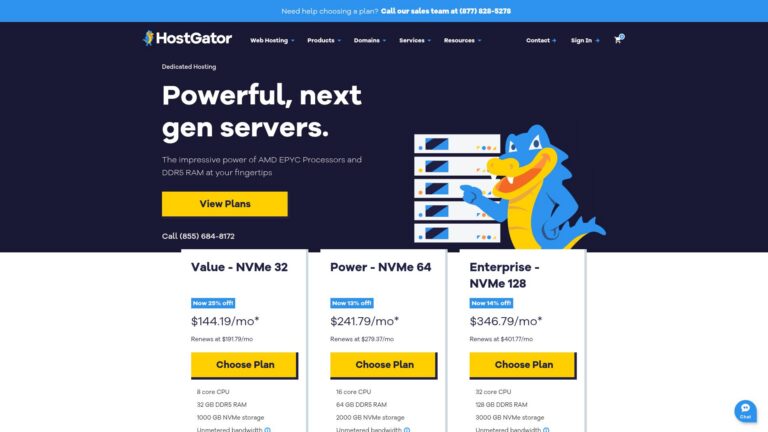
| Named NVMe SKU + cPanel | Three Linux/cPanel SKUs on AMD EPYC + DDR5: Value NVMe 32 (8 cores / 32 GB / 1 TB), Power NVMe 64 (16 / 64 / 2 TB), Enterprise NVMe 128 (32 / 128 / 3 TB). Full root on every line. | You want a published cPanel metal SKU, not a custom quote. | You need a colo catalog with city pickers, 10G ports, or GPU SKUs — that is not this page. |
| Windows / Plesk shops | The same three SKUs are sold as Windows with Plesk (and Plesk Application Vault). Linux stays cPanel/WHM. | Your stack is Windows and you will live in Plesk. | You need Linux without a control panel as the default SKU — root exists, but the checkout packages are cPanel-named. |
| US-DC only | The comparison grid marks US-based data centers on every dedicated plan. No city picker on the dedicated page. | US residency is enough and you do not need a named EU/APAC facility as the product. | You must pick Frankfurt, Amsterdam, or Singapore as a SKU filter. |
| Intro-price, then regular rate | Headline prices are first-invoice / intro discounts. Copy says plans renew at the regular rate in the control panel. Free cPanel-to-cPanel migration is a courtesy: 12+ month term, request within 30 days. | You will model the renewal rate before you buy, and you are migrating from cPanel. | You treat the intro number as the long-term price, or you need a guaranteed free migrate from a non-cPanel source. |
HostGator organises its dedicated server lineup around one structural decision: how much administration the provider handles versus how much stays with you. The fully managed tier covers patching, monitoring, and routine maintenance — designed for teams without an in-house sysadmin. The value-tier option returns those responsibilities to you, which suits teams with existing Linux administration capacity but leaves a real operational gap if that capacity is absent.
Picking the wrong management tier at signup can cost far more to fix than the price difference ever saved.
Choosing the wrong management tier is the most common misstep at the plan-selection stage, and neither tier can be retrofitted cheaply once you are live.
Within that structure, plans are standardised rather than configurable. CPU generation, RAM capacity, and storage type are bundled into fixed tiers; you cannot specify components independently the way you can with bare-metal providers that publish granular hardware sheets. If your workload has been sized against specific benchmark requirements, verify that HostGator’s published specifications match those requirements before committing — the catalogue is not built for precision mapping.
The offer suits a defined buyer: a team stepping up from shared or VPS hosting that wants a meaningful resource increase, values cPanel continuity, and needs managed support without building infrastructure from scratch. Teams that subsequently need compliance-specific configurations, granular hardware selection, or multi-region redundancy will encounter the lineup’s ceiling quickly — at which point the question is not which HostGator plan to choose, but whether to move beyond it entirely.

cPanel familiarity and round-the-clock managed support make the jump from shared hosting smoother than most buyers expect.
HostGator in daily use: operational implications
The transition from shared or VPS hosting is genuinely low-friction. cPanel provides a familiar control surface for administrators who are not infrastructure specialists, and the fully managed support tier delivers 24/7 response across phone, chat, and ticketing — meaning off-hours incidents do not require internal escalation. If your team lacks dedicated sysadmin capacity, that coverage carries real operational weight.
Experience shifts once the initial promotional period ends. On the less managed plan, server administration falls substantially to you — workable with in-house sysadmin capacity, but a meaningful staffing gap if that assumption proves optimistic. Budget planning carries its own friction: promotional and renewal rates can diverge considerably, and that divergence is not always visible at the point of purchase.
Treat the renewal figure as a required data point in your evaluation, not an afterthought.
Hardware transparency is the remaining practical constraint worth flagging. Public specification detail on CPU generation, RAM type, and storage throughput is limited, which makes pre-purchase capacity planning harder than it should be for workloads involving sustained database queries or high-throughput processing.
For general-purpose deployments this rarely blocks a decision, but if your team needs to validate specific hardware configurations before committing, resolve that through a direct pre-sales conversation — standard onboarding documentation will not substitute for it.
Conclusion – Is HostGator the right choice for you?
HostGator’s dedicated server offering is best understood as a managed accessibility play: it removes the operational complexity that makes bare metal hosting prohibitive for smaller teams, bundles familiar tooling to keep the management model predictable, and provides a support structure suited to teams stepping up from shared or VPS environments. The trade-offs are equally clear.
Teams with compliance mandates, precise hardware sizing requirements, or requirements for the strongest available uptime commitments will encounter structural limits that no amount of managed support can bridge. The lineup rewards teams making a clean step up from shared or VPS environments — not teams architecting mission-critical infrastructure from the ground up.
If your workload fits that profile — growing traffic, a need for dedicated compute, and a preference for managed support over in-house sysadmin overhead — HostGator deserves a closer look. The plan structure is coherent, the included tooling reduces hidden costs, and the management options give you a genuine choice between control and convenience. Visit the Dedicated Server page to see the current configuration options and decide whether the offer aligns with your infrastructure roadmap.