

Full-disk or block-device encryption protects data stored on the encrypted device while that device is locked. After the volume is unlocked, authorized processes—and attackers who compromise the running system with sufficient privileges—may access decrypted data. Boot components may also remain outside the encrypted boundary depending on the configuration.
Volume-level encryption targets specific logical volumes or partitions, giving teams the flexibility to apply stronger controls only where regulated data actually lives. Neither approach is universally superior.
What Is Encryption at Rest on a Dedicated Server?
Encryption at rest encodes stored data so that it cannot be read without the required key. On a dedicated server, protected storage may include operating-system volumes, data volumes, swap, temporary files, snapshots, and local backups.
Each of these locations can hold fragments of sensitive information, and each represents a distinct exposure point if a physical drive is removed or a decommissioned server leaves the data center without proper sanitization.
The single-tenant nature of a dedicated server changes the threat model in a meaningful way. On a shared or virtualized platform, the provider's hypervisor layer sits between your workload and the hardware — introducing a trust dependency and an attack surface you do not control. On bare-metal infrastructure, no other tenant's processes run on the same physical machine, and no hypervisor mediates your storage access.
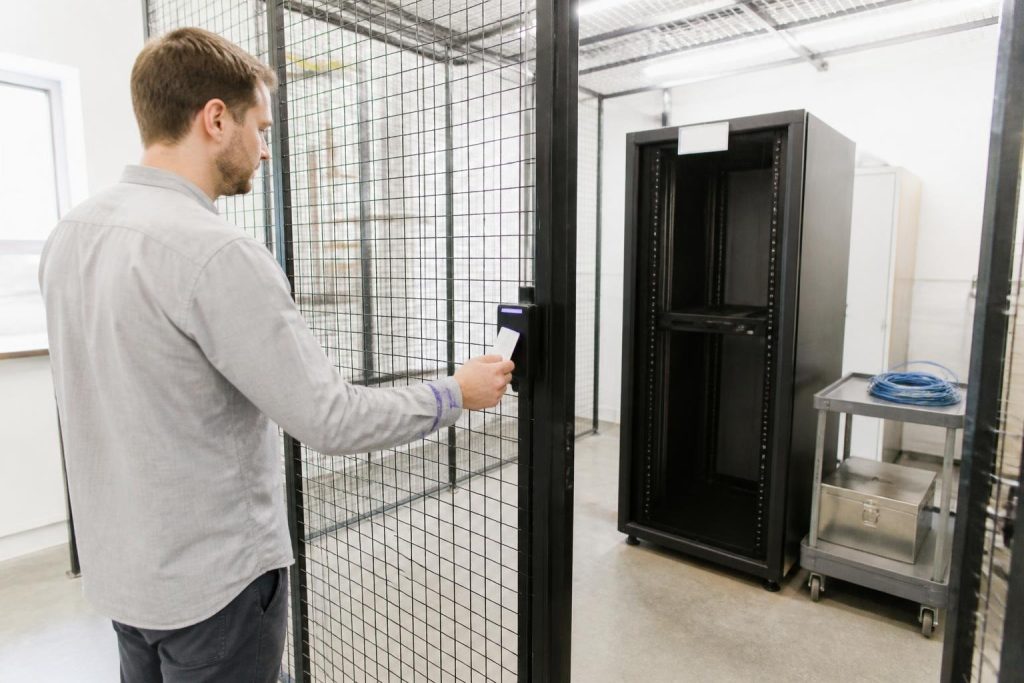
That exclusivity removes one class of risk: a co-tenant cannot reach your data through a misconfigured virtualization boundary. It also sharpens the threat that remains. If an attacker gains physical access to the drive — through a data center breach, an improper disposal process, or an unencrypted drive swap during a hardware failure — unencrypted data is immediately readable. Physical access is your primary adversary, and encryption at rest.
This is precisely where encryption at rest earns its place in a compliance architecture. A well-structured dedicated server deployment treats encryption at rest as a foundational control from initial provisioning, not a configuration detail addressed after the workload goes live.

When dm-crypt intercepts every write at the block layer, no plaintext ever reaches the physical medium, making the encryption boundary as broad and unconditional as possible.
Full-Disk Encryption with LUKS and dm-crypt – How It Works
Full-disk encryption using LUKS and dm-crypt operates at the block device layer, meaning every sector written to a physical drive is encrypted before it reaches the storage medium. The protection applies uniformly. Nothing is written in plaintext, regardless of which application or process generates the data.
The architecture works through a thin kernel module that intercepts all read and write operations between the file system and the physical drive. When the server boots, a passphrase or key file unlocks the LUKS header, which stores the master encryption key in an encrypted form. That master key is then used to decrypt the block device on the fly.
From the operating system's perspective, the disk behaves like any unencrypted volume — but every byte that reaches the physical medium has passed through the encryption layer. This design means that a drive physically removed from the server presents only ciphertext to anyone without the key.
The compliance advantage of this approach is scope completeness. Because encryption applies to the entire block device rather than selected directories or volumes, there is no residual plaintext left in swap partitions, in temporary files created during database operations, or in regions the file system considers unallocated.
Full-disk coverage removes the need to enumerate every sensitive data path individually, which simplifies the documentation you produce for an audit.
One practical consideration is the boot sequence. Full-disk encryption typically requires either a pre-boot passphrase entry or a network-based key retrieval mechanism, since the kernel itself must be available to unlock the volume.
Managing that unlock process securely — particularly on remotely administered bare-metal infrastructure — is a configuration decision with direct compliance implications. Cryptographic Key Management on a Dedicated Server – No KMS Required addresses the key lifecycle details that this architectural choice depends on.
Volume-Level Encryption – When Selective Protection Makes More Sense
The architectural question that follows is granularity: when a single physical server hosts workloads of genuinely different sensitivity, applying one cryptographic boundary across the entire block device forces regulated and non-regulated data to share the same key lifecycle, the same rotation schedule, and the same audit surface — compliance overhead that can outweigh the simplicity benefit.
Rotating one regulated volume's key leaves every other logical boundary untouched, shrinking both risk and disruption.
Volume-level approaches resolve this by encrypting individual logical volumes or filesystems independently, each with its own key and access policy. Encrypting only the sensitive volume keeps the cryptographic perimeter tight, reduces the blast radius of a key compromise, and limits how many systems must be in scope during an external audit.
Key rotation scope shrinks accordingly: rotating the key for one regulated volume leaves every other logical boundary completely untouched, avoiding the full-device re-encryption cycle that can be time-consuming and disruptive on large NVMe arrays.
This separation also simplifies key rotation scope: when you rotate the key for the regulated volume, the process touches only that logical boundary rather than requiring a full-device re-encryption cycle, which can be time-consuming and disruptive on large NVMe arrays.
Volume-level encryption also gives you finer control over how regulated data is isolated from non-regulated storage on the same physical host.
If you can demonstrate through documented volume mapping that cardholder data or protected health information lives exclusively within an encrypted logical volume — and that other volumes have no access path to that data — auditors have a clear, bounded scope to examine. This precision reduces the documentation burden during evidence overview.

Choosing between full-disk and volume-level encryption before deployment avoids the far costlier disruption of retrofitting protection onto a production storage array after a compliance gap is discovered.
How Do Full-Disk and Volume-Level Encryption Actually Compare?
Using one encrypted device can simplify key inventory, but losing all usable key slots or the required recovery material can make the entire device inaccessible. Using separate encrypted volumes can limit the impact to one logical volume, although it increases key-management complexity.
The decision turns on five practical dimensions — coverage breadth, key management complexity, performance overhead, operational recovery risk, and auditability — and no single option wins cleanly across all five.
A constraint that often tips the decision is recovery risk under key loss: full-disk encryption uses one key per device, which simplifies inventory but means a single lost or corrupted key renders the entire block device unreadable — operating system, swap, and all data volumes simultaneously.
Volume-level encryption limits that blast radius to one logical boundary, but it multiplies the number of keys in circulation and demands a more mature key management process to avoid a different failure mode: orphaned encrypted volumes whose keys have rotated out of inventory without a documented successor.
Volume-level encryption leaves those peripheral storage areas exposed unless you explicitly add a separate encrypted swap volume, which adds configuration complexity.
Key management complexity shifts in the opposite direction. Full-disk encryption uses one key per device, which can simplify inventory. The single compromise affects the entire block device.
Performance overhead is real but rarely decisive on modern hardware. AES-NI hardware acceleration, present in current-generation server processors, reduces the encryption penalty to a level that most production workloads do not notice under normal I/O patterns. Benchmarks vary by workload type and storage medium, so teams running write-intensive databases should validate against their specific I/O profile before committing to either approach.
Operational recovery risk is highest with full-disk encryption: a corrupted key or failed unlock mechanism can render an entire server inaccessible. Volume-level encryption limits that blast radius to the affected volume. Auditability, finally, is stronger with volume-level strategies — auditors can examine a precisely bounded scope rather than attesting to the security of an entire device.
Key Management Principles That Determine Whether Encryption Holds Up
Changing or rotating a LUKS passphrase or key slot does not normally require re-encrypting every data block. Re-encryption is required when changing the underlying volume key or cryptographic parameters, depending on the LUKS version and procedure used.
Encryption is only as strong as the process that protects its keys. Key management is therefore not an operational afterthought; it is the primary control that determines whether your encryption investment holds up under scrutiny.
- Generate keys from high-entropy sources using the operating system's cryptographically secure random number generator
- Never store key material on the same volume or device it protects
- Maintain offline or hardware-secured copies of LUKS headers and key files to enable recovery
- Define and enforce a documented key-rotation schedule tied to compliance review cycles
- Restrict access to key material by role, with audit logging on every retrieval or use
- Use strong, unique passphrases or key files rather than system defaults or predictable inputs
- Document the algorithm, key length, and key custodian for every encrypted volume as audit evidence
Secure key generation starts with entropy. Keys derived from predictable passphrases, system defaults, or insufficiently random seeds remain weak regardless of the encryption algorithm. Encryption also does not create access or audit records. The companion article Dedicated Server Audit Logging — Build a Stack covers the logging evidence that encryption leaves open.
Unencrypted swap partitions, missing LUKS header backups, misplaced key material, and incomplete algorithm documentation are the four recurring findings most likely to stall a compliance audit before it concludes.
Performance Trade-Offs – What Encryption Costs at the Hardware Layer
On modern dedicated hardware with AES-NI processor support, the CPU overhead of AES-XTS encryption is negligible for most workloads. The instruction set offloads the cryptographic computation to dedicated silicon, so general-purpose applications, web servers, and standard database reads rarely show a measurable throughput difference compared to unencrypted storage.
AES-NI moves cryptographic work off the general-purpose cores, so most web workloads never feel the cost.
The performance cost becomes a real engineering concern only in specific, high-intensity scenarios — and identifying those scenarios before provisioning is the decision that separates a well-designed encryption strategy from one that creates operational friction.
The workloads where overhead becomes relevant share a common profile: sustained, high-concurrency I/O against latency-sensitive storage. A high-IOPS transactional database performing thousands of small random reads per second will encounter more encryption-related latency than a file server handling large sequential transfers.
Similarly, a video transcoding pipeline writing large intermediate files at high throughput operates under a different pressure than a web application reading cached content. For these intensive workloads, volume-level encryption placement offers a practical advantage: encrypting only the volumes that hold regulated or sensitive data allows the highest-throughput paths — scratch disks, temporary processing buffers, or non-sensitive media caches — to operate without encryption overhead.
That selective boundary keeps compliance scope intact while preserving the raw I/O performance the workload requires.
NVMe SSD storage, now standard on current-generation bare-metal configurations, changes the calculus compared to older spinning disk environments. Because NVMe drives already deliver substantially higher sequential and random throughput than traditional storage, the proportional impact of encryption overhead shrinks further.
The practical implication is that most organizations deploying on modern dedicated hardware will not need to choose between encryption and performance — they need to choose encryption architecture thoughtfully.
Which Compliance Controls Does Encryption at Rest Satisfy — and Which Does It Not?
Encryption at rest does not satisfy access-control, audit-logging, monitoring, incident-response, or transmission-security requirements by itself.
Demonstrating compliance requires documented evidence that data stored on the server is rendered unreadable to unauthorized parties — and a properly configured full-disk or volume-level encryption implementation, paired with a documented key management policy, provides exactly that evidence.
AES-256 with documented key rotation satisfies the cryptographic strength requirement under both frameworks.
What encryption at rest does not satisfy is equally important to map. It provides no evidence for audit-logging or monitoring controls because it does not record who accessed data or when. It does not replace access control requirements: an authenticated but over-privileged user can still read decrypted data at the application layer.
Encryption does not create access or audit records. The companion article ‘Dedicated Server Audit Logging — Build a Stack’ covers the logging evidence that encryption leaves open.
A structured dedicated server configuration that maps each encryption decision to its corresponding control identifier — and documents the gaps explicitly — gives auditors the organized evidence package they need without requiring last-minute reconstruction.
Unencrypted swap partitions, missing LUKS header backups, misplaced key material, and incomplete algorithm documentation are the four recurring findings most likely to stall a compliance audit before it concludes.
What Are the Most Common Encryption Gaps That Auditors Flag?
The four encryption findings that most reliably delay or derail compliance assessments are unencrypted swap partitions, missing LUKS header backups, key material stored on the same volume it protects, and absent documentation of the encryption algorithm and key length. Each of these gaps is preventable, and each is routinely discoverable before an auditor arrives — if the diagnostic work is done deliberately.
- Unencrypted swap partitions that expose memory pages written outside the protected volume
- Missing LUKS header backups, leaving encrypted volumes unrecoverable after header corruption
- Key material stored on the same volume it protects, negating the cryptographic boundary
- Absent documentation of the encryption algorithm and key length used on each volume
- Temporary file directories left outside the encrypted boundary despite holding sensitive fragments
- No defined key rotation schedule or evidence that rotation has been performed
- Decommissioned drives leaving the data center without verified sanitization or encryption confirmation
Swap partitions are the most frequently overlooked surface. When a Linux system writes memory pages to swap, that data bypasses the encrypted volume entirely if swap is not itself encrypted.
The diagnostic step is straightforward: verify that swap is either disabled, encrypted as a separate volume, or configured as an encrypted partition within the LUKS setup before provisioning is finalized.
LUKS header backup is the second persistent gap. Auditors examining recovery procedures will request evidence that header backups exist, are stored separately from the protected volume, and are themselves protected.
Teams that cannot produce that evidence face a finding even when the encryption implementation itself is sound.
The third and fourth gaps — key material co-located with the data it protects, and undocumented algorithm and key-length choices — compound each other. An auditor cannot assess cryptographic strength without written records specifying the cipher suite and key length in use. A focused dedicated server configuration framework addresses each of these pre-audit checkpoints systematically, mapping diagnostic steps to the specific control identifiers that auditors will examine.
Conclusion – Encrypt Deliberately, Document Everything
Encryption at rest on a dedicated server is only as strong as the decisions made before the first byte is written. Choosing between full-disk and volume-level encryption, selecting a validated cipher and key length, separating key material from the data it protects, and closing overlooked surfaces such as swap — each of these is a deliberate engineering choice, not a default.
An auditor needs a traceable path from control requirement to configuration decision, not just a working cipher.
The compliance value of encryption comes not from the technology alone but from the documented evidence that auditors can trace from a control requirement to a specific configuration decision and back again. Deliberate documentation transforms a technically sound setup into an auditable one.