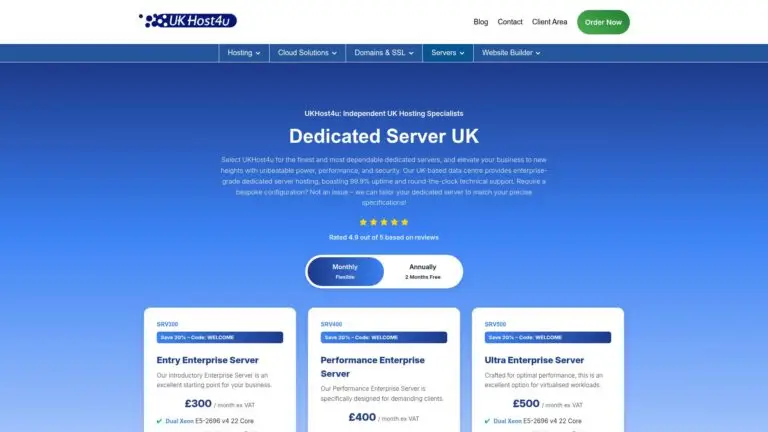

A cheap bare metal server sounds straightforward: you pay a low monthly rate and get an entire physical machine to yourself. The reality is more layered. The advertised price often reflects the base hardware rental alone, while control panels, additional IP addresses, hardware firewalls, and remote management tools arrive as line items that quietly reshape your actual monthly spend. Understanding that gap before you sign is what separates a genuinely good deal from an expensive lesson.
This article maps the true cost structure of entry-level dedicated server plans — what the headline price typically includes, which add-ons appear most often, and how choices around management level, bandwidth policy, and hardware generation affect your total outlay over a 12- to 36-month horizon. If you want a deeper breakdown of mid-range and premium pricing tiers alongside renewal markup patterns, How Much Does a Dedicated Server Cost per Month covers that ground in full.
The goal here is practical: equip you to compare budget bare metal options on equal footing rather than on promotional figures alone.
What Is a Bare Metal Server — and What Cheap Actually Means
A bare metal server gives you sole tenancy of physical hardware — dedicated CPU, RAM, and storage with no hypervisor layer and no competing workloads sharing your resources. The advertised monthly rate covers that baseline and nothing more. “Cheap” in this context means the entry tier of single-tenant physical rental, typically starting between €30 and €80 per month depending on hardware generation and location — not a discounted version of a shared or virtualised product. That distinction matters because bare metal pricing structures differ from cloud or VPS billing in one critical way: the fixed monthly rate creates an illusion of cost predictability that the add-on layer systematically undermines.
The two variables responsible for most invoice divergence are bandwidth policy and default hardware inclusions. Some providers bundle traffic within an unmetered port allocation; others apply per-gigabyte billing once you exceed a monthly ceiling. That structural difference alone can outweigh the visible price gap between competing plans before a single optional add-on appears on your invoice. Control panel licensing, out-of-band remote access via IPMI, and additional IPv4 addresses follow the same pattern — these add-ons can become difficult to remove after workflows or applications depend on them, so include them in the initial cost model where required — yet none appears in every standard entry-level price. The provider with the lowest base rate frequently carries the highest volume of unbundled add-ons, which makes the headline figure the least reliable basis for comparison.
Working through that sequence before you shortlist any provider gives you a consistent unit of comparison — true total monthly cost under your actual usage conditions — rather than a headline figure that reflects only the most favourable assumptions a vendor chose to advertise.

That low monthly rate buys you hardware access, nothing more — every add-on starts a new line on your invoice.
Hidden Costs Inside a Bare Metal Price Tag
The advertised rate on a budget bare metal plan covers one thing: a defined hardware configuration with single-tenant access. CPU, RAM, and local storage are included. Almost everything else is a potential line item.
Several add-ons reliably appear on invoices that the headline price obscures. Windows licensing adds a recurring fee that Linux deployments avoid. Control panels such as cPanel or Plesk, hardware firewalls, and additional IPv4 addresses are rarely bundled at entry level. RAID configuration is sometimes treated as a chargeable provisioning step rather than a standard inclusion.
Out-of-band remote access — IPMI or an equivalent — follows the same pattern. What a typical entry-level plan actually includes as standard is narrow: one IPv4 address, an unmanaged Linux OS, and a basic network port.
Two structural variables determine whether the headline price holds over time. First, traffic and DDoS bundling: As of September 2026, some providers — for example IONOS* on its published dedicated-server plans at ionos.com/servers/dedicated-servers — advertise unmetered traffic and DDoS protection as standard inclusions. Always verify the live offer page, because bundling changes. That packaging difference still matters versus providers that meter bandwidth or bill protection separately.
Second, renewal price stability: some providers lock the monthly rate at signup for the contract term, removing repricing risk entirely, while others do not. Both variables are invisible in the advertised rate and material to your actual 12- to 24-month cost.
Which Add-Ons Inflate Your Bare Metal Invoice?
Add-ons at entry-level bare metal pricing fall into three categories: security layers, management interfaces, and control panels. Understanding which category each item belongs to — and what it costs — is more useful than treating them as an undifferentiated list of optional extras.
DDoS mitigation and hardware firewall protection are sold separately, and assuming otherwise can silently double your security spend.
On the security side, the most consequential mistake is conflating DDoS mitigation with hardware firewall protection. The two operate at different network layers: volumetric flood traffic is handled at the network edge, while stateful packet inspection and access-control enforcement happen closer to your server. A plan that bundles one will still bill separately for the other. Selecting a configuration based on a single advertised security capability without pricing the complementary layer can silently double your security spend before any workload is deployed. Treat these as two separate line items when comparing plans, not as interchangeable features.
IPMI or equivalent remote management access — essential for any server you cannot physically reach — is frequently listed as an optional extra rather than a default inclusion at entry-level price points. This matters operationally: without it, a failed boot or misconfigured network interface requires either a support ticket with unpredictable response times or a paid hands-on intervention. cPanel and Plesk carry monthly per-licence fees that are rarely absorbed into entry-level pricing, and these fees scale with the number of accounts or domains your workload requires, making them a variable cost that grows alongside your usage. Taken together — a hardware firewall, remote management access, and a control panel licence — these items routinely add a fixed monthly sum that is large enough to shift which plan represents the better value at the total-cost level. Mapping each against your actual operational requirements before committing is the most reliable way to calculate what a plan will genuinely cost at invoice.

Promotional pricing and setup fees can quietly add months of cost before your first workload ever runs.
Setup Fees and Renewal Markup Risks Explained
Provisioning fees and renewal markups are where bare metal contracts most reliably exceed their advertised price. Setup charges vary from zero to the equivalent of one or two months of service, and that figure is not always flat — custom RAID configurations and non-standard hardware builds frequently carry a higher provisioning cost than the base listing suggests. Confirm the exact setup fee for your specific configuration before comparing providers, not after signing.
Renewal pricing is where multi-year budget projections most often collapse. Promotional rates are standard practice across the bare metal market, and the gap between an introductory price and the standard renewal rate can be substantial over a 24- or 36-month contract. Most providers offer no protection against this shift, and few state the renewal rate clearly in an initial quote. Before committing, request the post-promotional rate in writing.
That single step changes the comparison entirely. A plan priced higher at month one can cost less by month twenty-four if its renewal rate holds steady, while a cheaper entry price paired with a significant markup at renewal will exceed it over the same period. Comparing providers on headline price alone ignores the variable that most reliably determines whether a bare metal contract stays within budget. Total spend across your full intended contract length is the only figure worth comparing.
Bandwidth and Management Tier in Cheap Plans
Bandwidth pricing structure deserves the same scrutiny as processor specification when you evaluate entry-level plans, because it determines whether the headline rate holds across a full contract term. Port-speed-capped unmetered bandwidth is the more predictable model for burst-heavy workloads: your ceiling is a fixed throughput rate rather than a usage counter that accumulates silently between billing cycles.
Metered plans, by contrast, expose you to compounding overage charges precisely when traffic spikes — the moment your infrastructure is under the most pressure.
Before committing to any metered plan, calculate your 90th-percentile monthly transfer volume (the level you exceed only 10 percent of the time) rather than your average, since averages mask the spikes that trigger overage charges. Workloads with seasonal or event-driven spikes breach metered ceilings far more often than average usage data suggests, and the difference compounds across a 12- or 24-month term.
Providers that appear cheaper on base hardware frequently recover margin through per-gigabyte overage rates, so confirm the bandwidth model, port speed, and overage pricing in writing before treating any headline figure as a reliable cost baseline.
The managed versus unmanaged decision carries a parallel risk. Choosing an unmanaged plan to reduce the monthly rate is legitimate if your team has the operational capacity to absorb OS-level troubleshooting, patching, and incident response. If it does not, the labor cost of covering those tasks typically exceeds the managed-tier premium — making the cheaper plan the more expensive one in practice.
Unmanaged vs Managed Bare Metal: How Support Tier Shapes Your True Cost
r your team can cover those tasks in principle, but whether the specific engineers with the relevant skills are reachable at 2 a.m. on a holiday weekend when an incident lands.
The calculation also hardens once you sign. Some providers treat management tier as a fixed contract attribute rather than a configurable service, meaning an upgrade mid-term triggers a full hardware migration — with associated downtime, data movement, and engineering hours — rather than a simple billing adjustment. That potential transition cost belongs in your initial tier decision, not in an emergency overview when the need has already become urgent.
Upgrading your management tier mid-contract can trigger a full hardware migration, not just a billing change.
The calculation also changes if your workload scales mid-contract. Adding managed services later is not always a configuration toggle: some providers treat management tier as a fixed contract attribute, meaning an upgrade requires a full hardware migration rather than a billing adjustment. Factor that potential transition cost — downtime, data movement, and engineering hours — into your initial tier decision, not as an afterthought when the need becomes urgent.

Choosing unmanaged to save money often shifts hidden labor costs onto your team's time and expertise.
How Do Cheap Bare Metal Servers Perform in Practice?
Budget bare metal configurations deliver meaningfully lower throughput than premium tiers for compute-intensive workloads — and the gap is structural, not incidental. Entry-level plans frequently rely on older-generation processors rather than current AMD EPYC or Intel Xeon, pair that hardware with SATA SSD or spinning-disk storage instead of NVMe, and connect to the network at 1 Gbps rather than 10 Gbps uplinks. Each of those choices compounds under sustained load.
For a concrete illustration: a video transcoding pipeline or an AI inference endpoint that saturates a 1 Gbps port will queue requests and introduce latency that no amount of CPU tuning resolves. The same workload on a 10 Gbps-connected server with NVMe storage clears that bottleneck entirely.
Similarly, database-heavy applications — where storage read latency directly affects query response time — will expose the difference between NVMe and SATA storage far more sharply than a static file server ever would. Modern dedicated configurations with NVMe SSD storage and DDR5 RAM represent the current hardware baseline among established providers, while budget tiers may still ship with DDR4 and mechanical or mixed storage arrays.
That said, not every workload exposes these constraints. A mail server, a low-to-mid-traffic content site, or a development and staging environment rarely saturates either storage bandwidth or network throughput. For those use cases, entry-level bare metal delivers the core benefit of hardware exclusivity — no noisy neighbors, no hypervisor overhead — at a price point that a premium plan cannot justify.
The practical decision rule is straightforward: profile your workload's storage I/O, CPU utilization pattern, and peak network throughput before selecting a tier. Workloads with spiky, burst-heavy demand reveal hardware-generation gaps quickly; steady, low-intensity workloads rarely do.
Calculating Total Bare Metal Cost Over Your Contract Term
To build a defensible total cost figure, use the confirmed renewal rate — not the promotional price — as your base, then amortise setup fees across your intended contract term and add control panel licensing, IPMI access charges, and bandwidth overage costs calculated against realistic traffic projections. Run this model across 12, 24, and 36 months for every shortlisted provider before making any commitment.
Two line items specific to entry-level bare metal contracts are most frequently missing from that calculation. First, renewal markup risk: even a modest post-promotional increase compounds materially over 36 months. If a provider declines to confirm its renewal rate in writing, record that refusal as a quantified cost risk with a conservative upside estimate — not as a detail to resolve later.
Second, physical reconfiguration charges: changing a storage layout or adding a drive on a bare metal server requires technician intervention, producing both a fee and potential downtime that instincts formed on cloud or virtualised infrastructure will cause you to underestimate.
These two items are worth isolating because they are structurally invisible in headline comparisons yet capable of shifting the true 36-month cost by a meaningful margin. A provider whose advertised rate looks 20 percent cheaper than a competitor’s may produce a higher total bill once reconfiguration fees and an unconfirmed renewal uplift are included. The model only works if every input reflects what will actually appear on your invoice.

Run the full 12–36 month math first — the cheapest monthly rate rarely produces the cheapest total bill.
What a cheap bare metal headline rate usually leaves out
| Cost layer | What the advertised price covers | What to confirm in writing |
|---|---|---|
| Hardware tenancy | A defined CPU, RAM, and local disk on a single-tenant machine | CPU generation, disk type, and whether the SKU is leftover hardware |
| Network | Often a capped or fair-use port rather than a committed uplink | Monthly cap, throttle policy, and overage rate |
| Operations | Usually unmanaged OS, patching, and monitoring | Remote-hands fees, hardware-replacement SLA, and support hours |
| Contract term | A promotional monthly rate that may not be the renewal rate | Setup fee, auto-renewal, and the confirmed renewal price |
Conclusion – What Cheap Bare Metal Actually Costs You
The more consequential risk in cheap bare metal is time. Promotional rates at signup often give way to higher renewal prices that compound quietly across a 24- or 36-month contract — and the add-on layer explored above accelerates that drift. Before committing to any plan, request the post-promotional renewal rate in writing, build a full 12- to 36-month cost model using the inputs from the sections above, and confirm in writing which add-ons are bundled versus billed separately.
A 24- or 36-month contract turns a quietly rising renewal rate into one of your largest hidden infrastructure costs.
Mapping your expected add-on requirements against each provider's published pricing — before committing — is the single most effective step you can take to ensure the low entry price reflects what you will genuinely pay throughout the contract term.