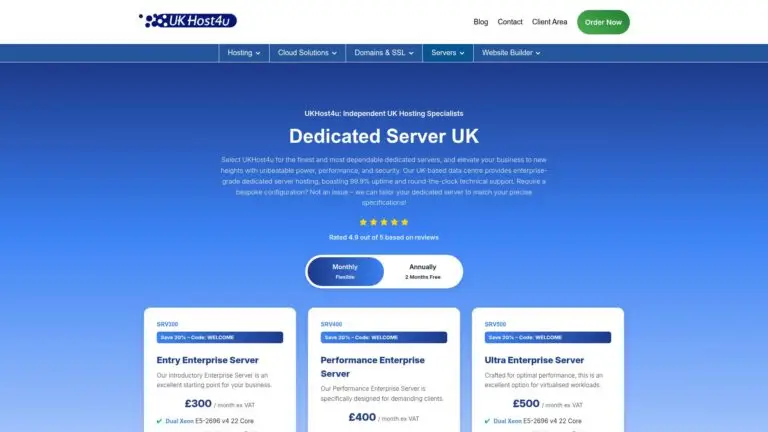

Monthly dedicated server pricing is rarely a single line item. Finance usually sees a base plan rate, but operations pays for hardware generation, RAM and storage tiers, management depth, bandwidth commits, and recurring licenses for control panels, backups, and security add-ons. This article maps those layers so you can build a defensible budget before you sign — and spot which advertised starting prices omit the cost drivers that appear after provisioning. Before signing a contract, most buyers want a clear answer to one question: what will this actually cost? The honest answer is that the monthly figure depends on several compounding layers.
Hardware tier sets the baseline. Management level adds another dimension: unmanaged plans are cheaper but demand in-house sysadmin expertise, while managed plans include monitoring and support at a higher price point. Bandwidth policies and add-on licensing can also affect total spend. Renewal pricing is a separate concern worth reviewing before committing to any contract term.
This article breaks down every cost layer in sequence so you can build a realistic monthly budget before committing. You will find a clear explanation of what drives prices at each tier and how to compare the total cost of ownership across providers rather than just the headline rate.
What layers make up a dedicated server monthly billing
The offer is built around the fundamental strengths of the dedicated hosting category: no hypervisor overhead, no shared tenancy, and direct access to the underlying hardware. For workloads such as high-traffic e-commerce, AI inference, video transcoding, or applications subject to compliance frameworks, that architecture provides a cleaner performance and security baseline than cloud or VPS alternatives.
The audience dedicated hosting addresses spans technically proficient teams seeking full infrastructure control as well as organizations looking for managed support — a range that reflects the broader market divide between unmanaged and fully managed bare-metal plans.
What the brand does not offer is a one-size-fits-all package. Hardware generation, management depth, bandwidth policy, and support quality all vary depending on the plan configuration a buyer selects. For buyers evaluating dedicated hosting, the practical question is which combination of hardware, management, and SLA terms aligns with their workload requirements and budget ceiling — a question this article addresses layer by layer.

Choosing bare-metal hosting means weighing isolation, performance consistency, and compliance requirements against the flexibility that virtualized alternatives offer across the same workload spectrum.
How dedicated pricing compares to VPS and shared hosting
Budget models should include Dedicated Server Contract Terms – What to Check Before You Sign so add-on billing and renewal traps stay visible.
VPS plans price a slice of a shared host; dedicated plans price the whole machine. A VPS quote bundles vCPU count, RAM cap, and storage with burst rules that throttle sustained load. A dedicated quote separates physical cores, memory, disk type, and port speed — then bills management and bandwidth separately. VPS providers use different CPU-allocation and fair-use models. Check whether vCPUs are dedicated or shared and whether sustained CPU usage is subject to throttling. If your workload needs full cores at peak, the VPS entry price is an anchor, not an equivalent tier.
For regulated workloads, compliance eligibility comes first: even a well-specified bare-metal offer becomes ineligible if the provider cannot supply the required audit documentation or data-residency commitments. Configuration depth and SLA terms matter only after that eligibility threshold is cleared.
Within that segment, certain capabilities have become baseline expectations rather than differentiators. For buyers in regulated industries, compliance posture determines whether a provider is even eligible for evaluation.
Understanding where an offer sits across hardware, management, bandwidth, and compliance requirements is essential to an accurate price comparison.
Who should budget for dedicated hardware — and who should not
Dedicated server hosting is a strong fit for teams that need guaranteed compute capacity and a clear hardware boundary — but the right match depends heavily on workload type, in-house technical capability, and compliance obligations. Understanding where this tier delivers and where it falls short saves a costly migration later.
A workload that has already hit the ceiling of shared resources is the clearest signal that dedicated hardware is the right next step.
- E-commerce platforms experiencing CPU throttling during peak traffic periods
- Gaming operators that cannot tolerate latency variability introduced by a hypervisor layer
- SaaS companies processing sensitive customer data under applicable compliance requirements
- Teams with in-house sysadmin capacity that want full control over a self-defined software stack
- Workloads that have already exposed the resource limits of shared or virtualized environments
- Buyers who need a guaranteed hardware boundary for security or regulatory reasons
- Teams that require predictable monthly compute spend without shared-tenancy risk
There is no shared CPU pool, no noisy neighbor consuming RAM at a critical moment, and no virtualization overhead capping throughput.
The buyer who should look elsewhere is one whose workload demands rapid horizontal scaling. Dedicated hardware provisions more slowly than cloud instances, and adding capacity mid-contract can be operationally disruptive. Teams without in-house sysadmin expertise and a tight budget should also weigh the management tier carefully: unmanaged plans require genuine Linux or Windows Server competence to operate safely, and skipping that step creates real security exposure.
Similarly, organizations whose user base is geographically spread across multiple regions should confirm that their chosen provider's data center footprint covers those locations.

Full hardware access becomes genuinely valuable at the exact moment virtualized environments reach their limits, particularly when bandwidth demands, latency sensitivity, or resource contention can no longer be managed through software alone.
Where dedicated servers justify higher monthly spend
Strong dedicated server offers distinguish themselves through a combination of hardware specification depth, network guarantees, and support responsiveness that sets a measurable baseline rather than leaving buyers to infer capability from generic category claims.
Depending on the provider and plan, available features may include metered or unmetered bandwidth, network-layer DDoS mitigation, managed support, and customer root access. Verify each inclusion in the service order.
Bandwidth flexibility surfaces as a meaningful differentiator precisely in high-throughput scenarios — media streaming or gaming platforms with thousands of concurrent sessions — where the choice of billing model (metered versus unmetered) directly determines whether monthly spend is predictable or volatile.
Network protection depth deserves the same comparative scrutiny as raw CPU and RAM figures, since an underpowered mitigation layer can negate the performance headroom that dedicated hardware otherwise provides.

The true monthly expense of bare-metal hosting extends well past the headline rate once control panels, managed support tiers, and hardware replacement agreements are factored into the total commitment.
Hidden cost traps before you sign a contract
Contract traps inflate bills more often than hardware upgrades. Model renewal step-ups explicitly. A plan promoted at $99 per month that renews at $149 adds $600 over the second year before any overages. Metered bandwidth at $0.10 per gigabyte beyond a 10 TB commit can add hundreds of dollars during a traffic spike if logs and backups also egress data. Treat the renewal rate, bandwidth cap, and add-on catalog as three separate line items in your spreadsheet — not footnotes to the headline figure.
Renewal step-ups, metered bandwidth overages, and mandatory control-panel fees routinely push the second-year total above the first-year promotional rate. The most immediate cost driver is still the base plan: bare-metal plans sit at a meaningfully higher monthly baseline than shared or VPS alternatives, and that gap widens once add-ons such as control panels, hardware firewalls, and remote access tools enter the picture.
- Provisioning timelines are slower than cloud infrastructure, making rapid scaling difficult during unexpected demand spikes
- Fixed hardware commitments reduce flexibility when workload requirements shift mid-contract
- Unmanaged configurations place full responsibility for patching, firewall rules, and security hardening on your team
- Teams running lean may face a genuine operational gap if a vulnerability goes unaddressed between check-ins
- Contract terms and SLA conditions warrant close review before signing, particularly around hardware-replacement timelines
Buyers who focus on the headline plan price without accounting for these line items may find the actual monthly spend diverges from the initial figure — a pattern worth examining before signing a contract.
Provisioning speed is a second constraint that surprises teams accustomed to cloud infrastructure. For workloads that need to scale rapidly in response to unpredictable demand spikes, the difference between bare-metal and cloud provisioning timelines is operationally significant.
The management burden deserves equal scrutiny. Unmanaged plans hand the operator full control and full responsibility: OS hardening, patch cycles, security configuration, and incident response all fall to whoever holds the credentials. Smaller teams without a dedicated sysadmin on staff can find that operational overhead quickly consumes the cost savings that made the unmanaged tier attractive in the first place.
Finally, data center coverage varies considerably across the market — providers with a single region introduce latency risk for globally distributed user bases that no hardware specification can compensate for.
How management tiers and hardware tiers stack costs
Most dedicated providers organize their offers around a straightforward axis: the degree of management handed to the customer versus retained by the provider. That structural choice — rather than a single flagship configuration — defines how the product lines differ from one another in practice. Buyers select a hardware tier first, then layer on a management level that determines how much operational responsibility they carry day to day.
Picking the wrong bandwidth model at signup can cost more than upgrading to a higher hardware tier.
At the unmanaged end of the range, the customer receives full control over the software environment.
At the managed end, the provider takes on monitoring, updates, and support escalation — reducing the operational surface for teams whose core competency is their application, not the infrastructure beneath it. The gap between these two poles is not cosmetic: it affects both the monthly cost and the internal staffing model required to operate the server safely.
Bandwidth policy adds a further structural dimension: some configurations ship with unmetered throughput at defined uplink speeds, while others apply monthly transfer caps. Choosing the wrong bandwidth model at signup is one of the more common sources of mid-contract cost overruns, since upgrading network capacity after provisioning is rarely seamless.

The management tier selected at signup determines whether day-to-day server responsibilities such as patching, monitoring, and incident response fall on your internal team or are absorbed by the provider.
Ongoing operational costs beyond the base monthly rate
Running a dedicated server day to day means taking on a set of operational responsibilities that go well beyond the initial provisioning decision.
On unmanaged configurations, the operator handles OS-level patching, firewall rule maintenance, and software updates without provider intervention. A security vulnerability in the kernel or a misconfigured network rule can remain unaddressed until someone on your team catches it. For teams running lean, this creates a real operational gap: the server may be physically exclusive, but the security posture is only as strong as the internal process around it.
Bandwidth policy also carries daily operational weight. Metered plans require active monitoring of transfer consumption; an unexpected traffic event can generate overage charges that appear only on the following invoice. Understanding which bandwidth model applies to your plan — and what the remediation process looks like when an SLA is breached — is a practical detail worth confirming before signing any contract.
Dedicated Server Cost Layers: Hardware vs Management vs SLA
| Criterion | hardware | management | SLA |
|---|---|---|---|
| Baseline monthly cost driver | CPU generation, core count, RAM, and storage tier | Unmanaged cheaper; managed adds monitoring and support fees | Uptime guarantees and response times priced into contract terms |
| Technical expertise required | None beyond selecting specs; hardware is provider-maintained | Unmanaged demands in-house sysadmin; managed offloads that burden | Legal and procurement review needed to validate audit documentation |
| Performance isolation | Dedicated CPU, RAM, and storage; no shared tenancy or hypervisor | Same physical isolation regardless of management tier chosen | Uptime commitments define guaranteed availability of that isolation |
| Scalability approach | Vertical only; changing specs often requires hardware migration | Managed plans may include migration support; unmanaged does not | Contract term length affects how quickly configuration changes apply |
| Compliance suitability | Single-tenant boundary supports data-residency and audit requirements | Managed plans more likely to include compliance documentation support | Audit documentation and data-residency guarantees are SLA-level commitments |
Illustrative Monthly Budget Scenarios (Entry, Growth, and HA)
Use ranges as sanity checks, not quotes. An entry production footprint — single application server, unmanaged OS, modest bandwidth — often lands between $120 and $180 per month once RAM and storage tiers are right-sized. A growth configuration with managed patching, nightly backups, and a hardware firewall commonly sits between $220 and $320 per month. A high-availability pair with redundant networking, larger storage pools, and a managed SLA tier can exceed $450 per month before software licenses.
Map each scenario to workload signals rather than vanity specs. Entry fits stable traffic with an ops-capable team. Growth fits rising concurrent users or heavier background jobs where patch cadence and backup retention are non-negotiable. HA fits revenue-linked uptime where failover and documented runbooks matter more than minimizing the base rate.
When you compare scenarios, include internal labor: unmanaged savings evaporate if engineers spend several hours each month on maintenance that a managed tier would absorb. The true monthly figure is hosting plus the opportunity cost of the people keeping the machine healthy.
Build a realistic monthly budget before you commit
A dedicated server earns its place when consistent, predictable performance is non-negotiable — not as a status upgrade, but as a structural requirement. The cost layers examined here (hardware generation, management tier, bandwidth model, and add-on licensing) each contribute to the real monthly figure, and the gap between a promotional headline price and the true total commitment can be substantial.
Teams that map those layers against their actual workload requirements before signing a contract are far better positioned to avoid mid-term surprises than those who optimize for the lowest advertised rate alone.
If your workload has outgrown shared or virtual environments, or if compliance obligations demand single-tenant isolation, the category warrants serious evaluation. Hardware exclusivity and a management tier matched to your internal capabilities are the primary levers worth prioritizing. To see how current configurations compare across those dimensions, explore the Dedicated Server options available and judge the fit for yourself.