
Hivelocity occupies a distinct position in the dedicated server market: a provider that owns its infrastructure, deploys bare metal at speed, and targets teams that need physical hardware without the delays typical of enterprise procurement cycles. For developers, agencies, and operationally lean businesses running demanding workloads, that combination can be genuinely compelling.
But a fast deployment promise only matters if the day-to-day support model and operational expectations match what your team actually needs. This article frames Hivelocity through the lens of buyer fit and daily operations — what working with the platform looks like after signup, how support is structured, and which workload profiles align well with what the provider genuinely delivers.
The focus is on practical expectations: response times, management depth, network reliability, and the scenarios where Hivelocity holds a real advantage versus where a different provider may serve your team better. Understanding those trade-offs matters because dedicated server contracts are not trivial to exit.
Choosing a provider whose support model does not match your team’s technical capacity — or whose data center footprint does not align with your audience geography — creates friction that compounds over time.
Hivelocity as a brand: who is behind the offering
Hivelocity is a Tampa-based infrastructure company that owns its data centers and operates its own hardware directly. When a drive fails or a NIC requires replacement, Hivelocity engineers have direct rack access — a structural advantage over reseller arrangements where repair timelines depend on a third party’s schedule.
That ownership chain also underpins faster bare-metal provisioning than most mid-market competitors can offer, because no intermediary sits between the platform and the physical layer.
Two conditions determine fit. First, verify Hivelocity’s current locations and test latency from the workload’s actual user and dependency regions. Second, confirm the management scope of the selected plan, including patching, monitoring, backups, security hardening, and incident response.
A managed add-on exists, but it covers operationally routine tasks and does not replace an internal network operations function.
Direct hardware ownership delivers meaningful value if your team handles Linux administration and network operations in-house — whether that is a solo operator with strong sysadmin depth or an engineering group of three to five people — and your users are concentrated in North America.

Hivelocity sits between budget resellers and hyperscale giants, carving out a focused niche for raw dedicated capacity.
Market position of Hivelocity among known providers
That positioning has a direct consequence: the managed tier Hivelocity offers carries a lower ceiling on compliance coverage, audit trail ownership, and cloud integration than enterprise-focused hosts provide at comparable price points.
The provider’s competitive position is most coherent for technically self-sufficient teams running US-concentrated workloads. Hivelocity’s published facilities have historically emphasized US capacity — verify the current location list — which can deliver advantages — dense domestic peering and predictable low-latency routing — for applications whose users are primarily businesses seeking US and international bare-metal capacity — verify current facility locations on Hivelocity’s official site.
For workloads serving geographically distributed users, compare the available facilities and measured routes with the required latency and resilience targets.
Team size matters here as a secondary fit signal. A solo operator or small team with Linux and sysadmin competency can extract full value from Hivelocity’s unmanaged default. Larger teams expecting delegated operational support will find the managed add-on insufficient for that purpose.
Who Hivelocity is for — and who should look elsewhere
Linux-competent solo operators and small teams are a natural fit. The sharper question here is where that fit breaks down — and how quickly a team can tell which side of the line they sit on.
A managed add-on buys breathing room, but its compounding cost can silently cancel the savings that drew you to bare metal.
The managed add-on is the most common mitigation, but it has a ceiling: it narrows exposure to operational incidents without replicating proactive monitoring or a dedicated account relationship. Treat it as a bridge rather than a destination — useful while skills are being built internally, but one whose cost compounds over contract length and can quietly erode the price advantage that made bare metal attractive in the first place.
Skill depth is the softer constraint but the faster-moving one: teams that are currently thin on Linux administration can close that gap over time, whereas the managed add-on buys breathing room rather than a permanent substitute — it narrows exposure without replicating proactive monitoring or a dedicated account relationship.
Gaming platforms and media streaming services belong in the same category: bare metal isolation keeps throughput predictable under sustained load, not only during off-peak windows.
The fit weakens along three clear axes: geographic location, technical capability, and operational needs. If the current facility list does not place infrastructure sufficiently close to the intended audience, evaluate a provider or multi-provider architecture with suitable regional coverage.
If your team lacks in-house Linux administration depth, the unmanaged default will expose that gap quickly; the managed add-on narrows it but does not replicate the proactive monitoring and dedicated account support that enterprise managed hosting specialists provide.
The provider earns its position when bare metal speed and regional network reach are the primary selection criteria and your team has the operational capability to own what runs above the hardware layer.

Owning its data centers and hardware gives Hivelocity a tight provisioning chain that few mid-market rivals can match.
Strengths that make Hivelocity stand out
Hivelocity’s clearest structural advantage is bare-metal provisioning on infrastructure it owns outright. Because the company controls its own data centers, hardware replacement cycles, and network routing within a single chain of custody, fast deployment for pre-configured hardware is an architectural outcome rather than a marketing position — though provisioning windows vary by configuration, so verify the applicable SLA before you commit to a timeline.
The management tier range is the second differentiator with direct bearing on whether Hivelocity fits your team. Unmanaged plans are the right choice if you have dedicated sysadmin capacity and want full root-level control without paying for bundled services you will not use. Managed tiers let a leaner engineering team delegate defined operational tasks — OS-level monitoring, routine maintenance — without switching providers as headcount grows.
Avoiding an infrastructure migration during active growth has compounding value: it removes scheduling risk and keeps engineering attention on the product rather than the platform.
Both advantages apply most cleanly to non-regulated, performance-sensitive workloads: SaaS applications, internal tooling, gaming infrastructure, and media delivery all benefit from single-tenant hardware isolation and predictable throughput.

Verify Hivelocity’s current facility list and test latency from the application’s actual user regions before selecting a location.
Trade-offs and weak spots of Hivelocity
Verify Hivelocity’s current official global location list before assuming every production facility is in the United States. For deployments serving users far from those sites, latency is a network architecture problem that faster hardware will not solve. If your audience extends meaningfully beyond the provider’s published regions, plan for a CDN layer or a regional secondary provider — after confirming current facility lists — before you commit, not after.
Compliance requirements introduce a harder disqualification. If your workload falls under any of those frameworks, treat this as a provider-fit issue rather than a gap you can close through post-deployment configuration or third-party add-ons.
The platform’s ecosystem depth creates quieter friction for teams with broader infrastructure needs. Dedicated hardware is handled competently, but managed databases, container orchestration, and serverless primitives sit outside the native offering — each requires an independent architecture decision and the engineering capacity to execute it. Brand authority in multi-stakeholder procurement also carries less internal weight than Tier-1 vendors, which can slow formal approval cycles.
If your team holds Linux and networking competency in-house, these gaps are workable. If you expect the platform’s ecosystem to absorb that burden, account for the additional engineering investment before signing.
Lineup and offer of Hivelocity at a glance
| Buyer | What they sell you | A fit if | Not a fit if |
|---|---|---|---|
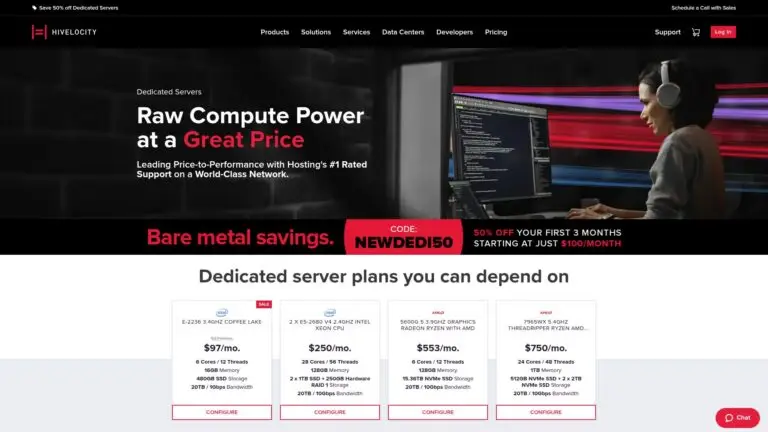
| E-2336 / E-2236 instant | E-2336 2.9 GHz Rocket Lake, 6c/12t, 32 GB, 480 GB SSD, 20 TB / 1 Gbps, $75/mo. E-2236 3.4 GHz Coffee Lake, 6c/12t, 16 GB, 480 GB SSD, 20 TB / 1 Gbps, $129 list / $97 sale. | A 6-core E-23xx or E-22xx instant SKU at 1G / 20 TB is enough. | You need 10G on these two Intel rows. 10G is on the Threadripper card. |
| 7965WX Threadripper | AMD PRO 7965WX 5.4 GHz, 24c/48t, 1 TB RAM, 512 GB NVMe + 2 TB NVMe, 20 TB / 10 Gbps, $682/mo. Same 20 TB traffic pool as the cheap Intel rows; different port. | You want 24 cores and 10G and will pay Threadripper money. | You want $75 with 10G and 1 TB RAM. That mix is not the E-2336 card. |
| 44 locations (ALB1, IAD3, …) | 44 sites: 22 North America, 13 Europe, 9 Asia Pacific. Examples: Albany NY ALB1 (core), Ashburn VA IAD3 (core) and IAD1 (edge). Custom hardware: 1–4 processors, up to 100 drives, 8 GB–1 TB RAM. 99.99% uptime SLA. 2+ Tbps network, 1,000+ peers. | You will pick a location code, then an instant SKU or a custom quote. | You want one unnamed bargain hall with no map. They sell 44 named sites. |
| Instant SKU or custom quote | If the instant options do not fit, they take a custom server quote. VLANs between dedicated servers and VMs are self-service. | You will take E-2336, E-2236, or 7965WX off the shelf, or file a custom quote. | You expected custom hardware as another named SKU on the same grid. Custom is a quote, not a fourth listed line. |
Hivelocity’s catalog covers four lines — dedicated bare-metal servers, colocation, virtual private servers, and network and IP transit — with dedicated servers as the commercial core. Procuring here means single-tenant hardware from an operator that owns the underlying infrastructure, not resold third-party capacity, which matters for teams that need predictable performance isolation.
Direct infrastructure control can simplify operational accountability, but performance still depends on the selected hardware, network path, facility design, workload, and contractual service levels.
Within dedicated servers, unmanaged plans give you full root access and unrestricted control over the software stack, making them a practical fit if your engineering team wants to configure the environment to a specific workload. Managed configurations reduce that operational overhead for teams without dedicated sysadmin capacity, though the managed tier is calibrated for straightforward production environments.
Colocation follows the same direct-ownership logic for customers who prefer to house their own hardware, with Hivelocity supplying rack space, power, and connectivity.
One operational characteristic worth noting: Hivelocity’s published provisioning SLA positions bare-metal deployment in minutes rather than hours, which is a meaningful differentiator if deployment speed affects your release cycle. What the catalog does not offer is a cloud-native managed services layer — container orchestration integrations and managed database tiers are absent.
Teams that need those components will source them independently, which is an explicit positioning choice toward raw infrastructure rather than platform abstraction.

Unmanaged tiers reward self-sufficient teams; buyers expecting hands-on provider support often find the model a poor fit.
Hivelocity in daily use: operational implications
Hivelocity’s daily-use experience is largely determined by team technical ownership: buyers who manage their own Linux and networking operations without expecting the provider to absorb complexity over time report consistent value from the unmanaged tier — predictable hardware, direct network control, and pricing that reflects infrastructure rather than managed-services overhead they do not need.
That limitation tends to surface at contract renewal rather than during initial deployment, once workload demands have grown beyond what the service structure supports. At that point the outcome is typically a migration rather than a service upgrade — a distinction worth settling during evaluation, not after.
Team technical fit is therefore the more reliable pre-purchase test than pricing tier alone. If your team treats the provider as a hardware and network layer and manages the software stack internally, the operational model is clean and cost-efficient. If you expect the provider to absorb increasing operational complexity as the environment matures, the unmanaged-first structure will generate friction rather than scale with you.
Resolving that question before signing determines whether Hivelocity’s daily-use profile becomes a durable operational asset or a recurring source of overhead.

Conclusion – Is Hivelocity the right choice for you?
If that description fits your situation, the combination of owned infrastructure, rapid provisioning, and straightforward bare-metal pricing is genuinely difficult to match at this tier.
If the available Hivelocity locations or management options do not satisfy the workload’s measured regional and operational requirements, evaluate providers with a better-aligned footprint or support model. In those cases, evaluating providers with broader geographic footprints or deeper managed service depth before committing to a dedicated server contract is the more prudent path.